In the classical tradition, fixed stars are not mere background decoration. They are precise celestial points that, when conjunct a planet or angle in a natal chart, modify its expression with a distinct and often dramatic flavor. Among these, Rastaban — the head of the Dragon — holds a peculiar place. In my thirty years of practice, I have seen it mark charts with a signature of intense ambition, sudden reversals, and a relentless drive for recognition. This article offers a practical summary of how to judge Rastaban in a natal chart, drawing on the work of Ptolemy, Robson, and Lilly.
What Is Rastaban and Where Does It Sit?
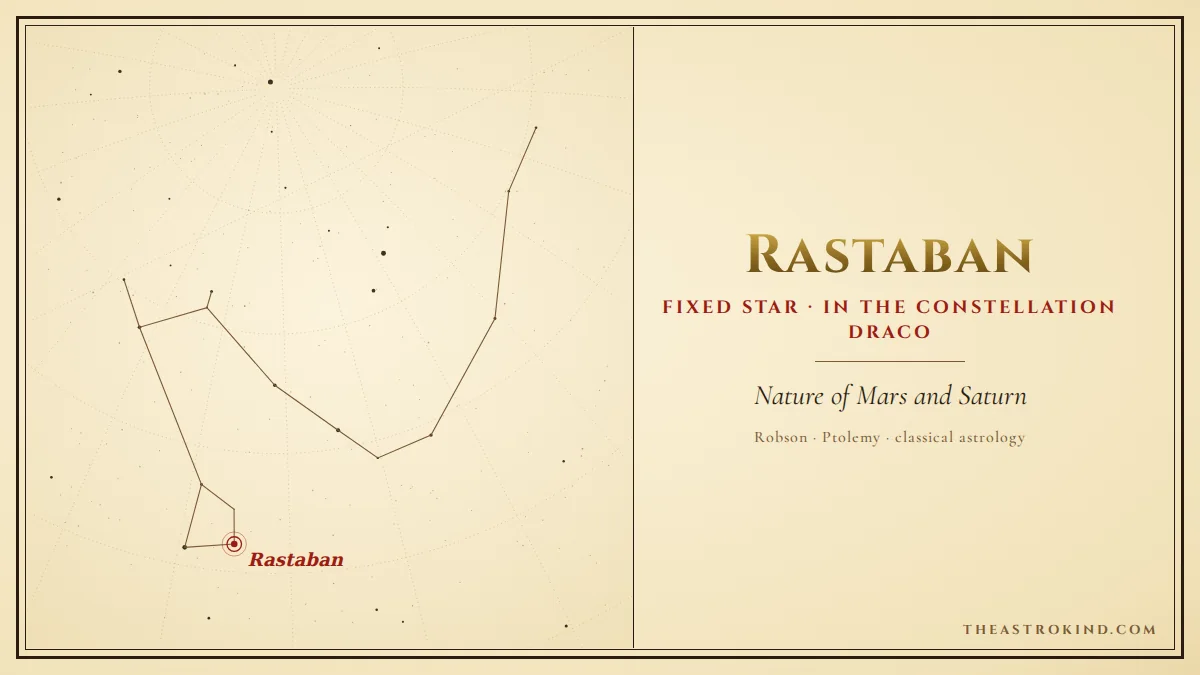
Rastaban is the traditional name for Beta Draconis, the second-brightest star in the constellation Draco. It marks the dragon's head, while Eltanin (Gamma Draconis) marks the eye. Both are powerful, but Rastaban carries a more volatile and martial quality. In the classical texts, Rastaban is associated with the nature of Mars and Saturn — a combination that speaks of ruthless determination, cunning, and the capacity to rise through conflict.
Its position in the zodiac is approximately 11°58′ Sagittarius (for the year 2000). Due to precession, this degree shifts by about 50 seconds of arc per year, so for a modern natal chart, you must calculate its exact position for the birth date. Robson, in his Fixed Stars and Constellations in Astrology, describes Rastaban as giving “loss and trouble, but also power and honor” — a paradox that demands careful synthesis.
The Dragon's Head in Myth and Astrology
In myth, Draco guarded the golden apples of the Hesperides and was slain by Hercules. This story encodes the theme of guarding treasure — often knowledge or status — and the necessity of struggle to obtain it. Astrologically, Rastaban in a natal chart often indicates a native who must fight for what they value, and who may face powerful enemies or rivals along the way. It is not a star of ease, but of hard-won achievement.
Bonatti, in his Liber Astronomiae, warns that stars of the dragon's head can produce sudden falls from grace if the native becomes arrogant. The key is to channel the martial energy into disciplined effort rather than reckless ambition.
How to Interpret Rastaban in a Natal Chart
The first step is to locate Rastaban by conjunction. It operates primarily within a 1° orb, though some authors allow up to 2° for the brightest stars. Check if any planet, the Ascendant, Midheaven, or the Moon's Nodes are conjunct Rastaban. The planet involved will show where the dragon's energy is most concentrated.
If Rastaban conjuncts the Sun, the native's core identity is marked by a drive for leadership and a tendency to attract opposition. With the Moon, it indicates emotional intensity and a protective, sometimes possessive, nature. Conjunct Mercury, it sharpens the mind for strategy and debate, but can also produce a sharp tongue. With Venus, it may bring artistic talent with a competitive edge, and with Mars, it amplifies courage and aggression.
When Rastaban aspects the Ascendant, the personality projects a formidable presence; with the Midheaven, career matters are highlighted, often involving power struggles or sudden changes in status. The Nodes are particularly sensitive: the North Node conjunct Rastaban suggests a destiny tied to leadership and conflict, while the South Node may indicate past-life patterns of domination or victimhood.
Rastaban and the Lunar Nodes
In my experience, the most striking manifestations of Rastaban occur when it conjuncts the Moon's Nodes, especially the North Node. This placement often marks individuals who are thrust into positions of authority, sometimes prematurely, and who must learn to wield power ethically. The dragon's head demands that one confront one's own shadow — the temptation to manipulate or dominate — and transform it into service.
Valens, in his Anthologies, notes that stars near the Nodes can indicate fated events and turning points. Rastaban, being at the head, suggests that the native's path is one of active engagement with the world, not passive acceptance.
Practical Examples and Cautions
Consider a chart with Rastaban conjunct Mars in the 10th house. This native might be a military officer, a surgeon, or a corporate executive known for decisive action. The danger is burnout or conflict with superiors. With Rastaban on the Ascendant, the person may have a piercing gaze and a reputation for being formidable — but also for making enemies easily.
It is crucial to avoid fatalism. Fixed stars are not curses; they are intensifiers. As Morin de Villefranche emphasized, the star's effect is filtered through the planet it contacts and the overall chart condition. A well-dignified planet can channel Rastaban's force into constructive leadership; a debilitated one may succumb to its shadow.
Students often ask me whether Rastaban is “good” or “bad.” The answer is neither. It is a star of power, and power is neutral. The moral quality depends on the native's choices. What Rastaban guarantees is that the life will not be dull — it will involve struggle, and through struggle, the potential for greatness.
In practice
- Calculate Rastaban's exact position for the birth date (around 12° Sagittarius for 2000) and check for conjunctions within 1–2° to planets, angles, or Nodes.
- Assess the condition of the conjunct planet: dignity, house, and aspects will determine whether Rastaban's energy manifests as constructive ambition or destructive conflict.
- Pay special attention to conjunctions with the Moon's Nodes, as these indicate fated turning points and tests of power.
- Always integrate Rastaban into the whole chart — never interpret it in isolation. The star modifies, but does not override, the natal promise.