This is a clean, apolitical astrological examination of the fixed stars in the natal chart of Pierre Poilievre. It takes no side, offers no opinion for or against him or his party, and predicts no election outcome. The birth time is not known with certainty; the chart used here is set for 12:00 local time in Calgary, Alberta, on 3 June 1979. Because the Ascendant, Midheaven, houses, and the exact degree of the Moon depend on an accurate birth time, we will not draw conclusions from them. Instead, we focus on fixed-star conjunctions to the Sun and the slow-moving planets, which remain valid for the entire day.
What the Fixed Stars Are and Why They Matter
In classical astrology, the fixed stars are the background of the zodiac, the unchanging points of light against which the planets move. Ptolemy in the Tetrabiblos and later Vivian Robson in his 1923 Fixed Stars and Constellations in Astrology assigned each star a planetary nature and a set of effects. When a planet is conjunct a fixed star within a close orb, the star's nature modifies the planet's expression, adding a distinctive tone to the character and the life events signified by that planet.
Robson's descriptions are often vivid and sometimes harsh, but they are not fatalistic. They describe tendencies and potentials, not inevitable fates. In the chart of a public figure, the fixed stars can highlight the qualities that shape a career and a reputation. Here we examine each conjunction found in the data, using only the orbs and natures given.
The Conjunctions to the Luminaries and Personal Planets
Moon conjunct Denebola (orb 0.06°)
Denebola, the star in the tail of the Lion, has the nature of Saturn and Venus according to Robson. He writes that it gives an "independent spirit, quick judgment, and leadership." The Moon in this chart is in Virgo, in the second house, and is conjunct Denebola almost exactly. This is a very tight orb, so the star's influence is strong. The Moon signifies the emotional nature, the instincts, and the public's perception of the person. With Denebola, there is a tendency to act from a place of self-reliance and to make rapid assessments. The Saturn-Venus nature adds a note of sober responsibility mixed with a desire for harmony, though the independence remains paramount.
Mars conjunct Almach and Menkar (orbs 0.12° and 0.21°)
Mars is conjunct two stars in the constellation of Andromeda and Cetus. Almach, with the nature of Venus, is said by Robson to confer "eminence, artistic talent, wide renown, and honors." Menkar, with the nature of Saturn, is more difficult: Robson lists "illness, disgrace, ruin, and wounds caused by..." (the text is truncated, but the tone is clear). Mars is the planet of action, drive, and conflict. When it is conjunct stars of such contrasting natures, the expression can be complex. The Venusian Almach may soften the Martian aggression and add a capacity for strategic action that earns recognition. The Saturnine Menkar may bring obstacles or a sense of struggle that must be overcome. In a public career, this could manifest as a fighting spirit that is both admired and criticized, with victories that come at a cost.
Mercury conjunct Rigel (orb 1.89°)
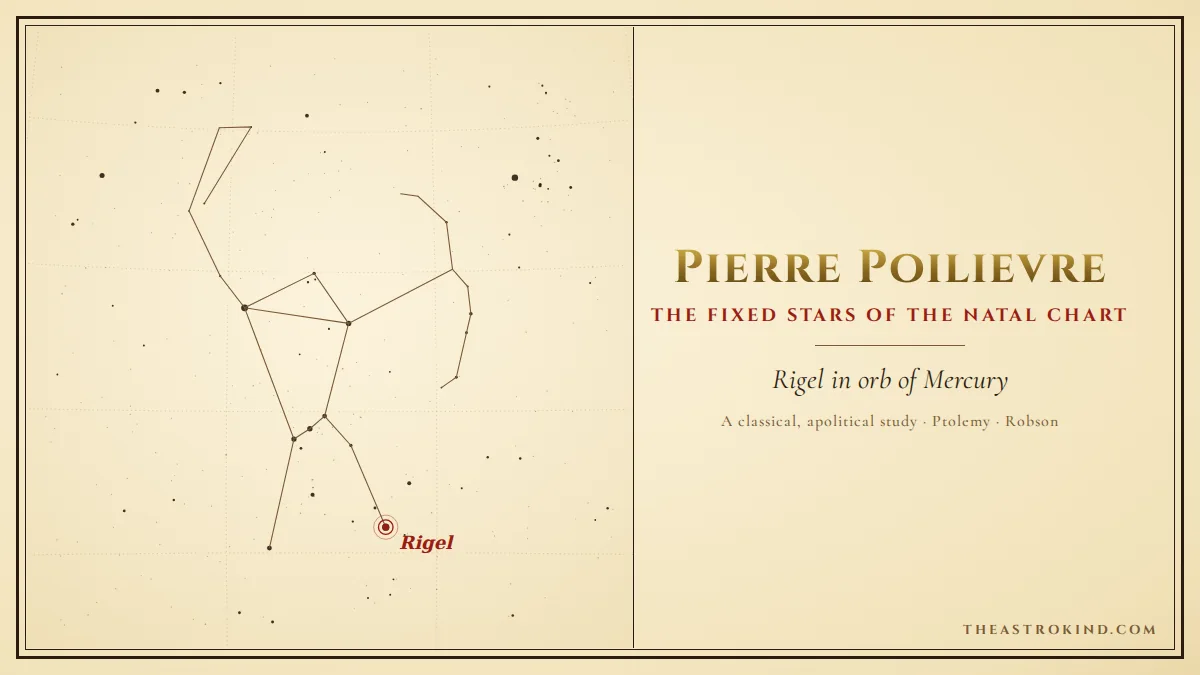
Rigel, in the foot of Orion, has the nature of Jupiter and Mars. Robson says it gives "revolutionary invention and martial splendor, generosity." Mercury is the planet of communication, intellect, and debate. In this chart, Mercury is in Gemini, its own sign, and conjunct Rigel. This suggests a mind that is inventive, forceful in speech, and capable of generating new ideas. The Jupiter-Mars nature adds a sense of mission and a competitive edge to the intellect. For a politician, this could indicate a talent for framing arguments in a way that captures attention and inspires followers, though the martial component may also lead to combative rhetoric.
Saturn conjunct Alioth (orb 1.02°)
Alioth, in the Great Bear, has the nature of Mars according to Robson, and he warns of "danger, anger, destructive nature, and catastrophes." Saturn is the planet of discipline, structure, and limitation. When Saturn is conjunct a star of Martian nature, there can be a tendency toward harshness or a rigid application of rules. In the character, this might show as a strong sense of duty and a willingness to enforce boundaries, but also as a potential for frustration or conflict with authority. The combination can indicate a person who is driven to build lasting structures but who may encounter fierce opposition along the way.
Pluto conjunct Seginus (orb 0.80°)
Seginus, in Boötes, has the nature of Mercury and Saturn. Robson associates it with "losses through friends and companies." Pluto is the planet of power, transformation, and hidden forces. This conjunction may point to experiences of betrayal or loss within group affiliations, or to a need to transform one's social circle. In a public life, it could suggest that alliances are fluid and that one must be cautious about whom to trust. The Mercury-Saturn nature adds a mental and strategic dimension to these losses, perhaps indicating that they come through miscommunication or rigid thinking.
Stars on the Angles: A Note of Caution
The data also lists the Midheaven conjunct Algol and the Ascendant conjunct Regulus. These are powerful fixed stars: Algol, the Head of Medusa, has a Saturn-Jupiter nature and is often associated with immense force; Regulus, the Heart of the Lion, has a Mars-Jupiter nature and signifies conquest and royalty. However, because the birth time is uncertain, the exact positions of the angles are unreliable. We cannot draw firm conclusions from these conjunctions. They are mentioned here only for completeness, but the reading should not rely on them.
How the Stars Combine
The fixed stars in this chart paint a picture of a complex and driven character. The Moon-Denebola conjunction gives an independent and quick-judging emotional core. Mars-Almach-Menkar adds a fighting spirit that can be both honored and wounded. Mercury-Rigel contributes a forceful and inventive intellect. Saturn-Alioth brings a disciplined but potentially harsh structure. Pluto-Seginus warns of losses through friends. Together, these stars suggest a person who is self-reliant, combative in speech, and capable of both inspiring and alienating others. The classical tradition would say that the stars do not compel, but they incline. They describe the tools one has to work with, not the use to which they are put.
In practice
- Focus on the tightest orbs: Moon-Denebola (0.06°) and Mars-Almach (0.12°) are the most significant.
- Consider the planetary natures: Venusian stars soften, Saturnine stars harden, Martian stars energize.
- Remember that the angles are unreliable without a birth time; do not base your interpretation on them.
- Use the fixed stars as a layer of nuance, not as a standalone predictive tool.