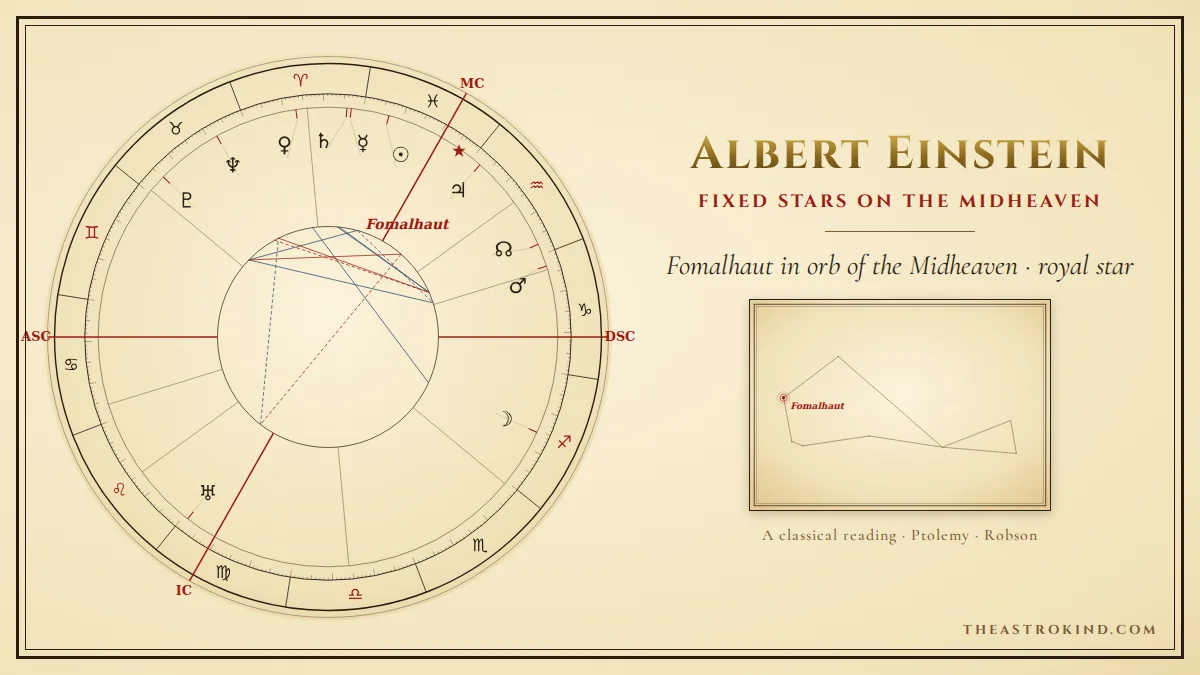
What if the key to understanding a person's public role lies not in the planets but in a distant star? In classical astrology, certain fixed stars—luminous suns that never set—can mark a destiny when they align with the Midheaven. This article explains the technique and shows it in action with Albert Einstein's chart, where the royal star Fomalhaut sits close to his Midheaven. You'll see how a fixed star on midheaven can illuminate career and reputation.
The technique: fixed stars on the Midheaven
The Midheaven (MC) is the point of the ecliptic that culminates at the moment of birth—the highest point the Sun reaches. It signifies career, public standing, and reputation. Fixed stars are distant suns that barely move over centuries. When a star conjoins the MC, its nature colors the native's public life.
To find this contact, astrologers compute the star's position in right ascension or oblique ascension—how it actually rises or culminates on the equator—and compare it to the MC. The orb allowed depends on the star's magnitude: 2°30′ for first-magnitude stars (mag ≤ 1.5), 1°30′ for second (mag ≤ 2.5), and 1° for the rest. A star within 1°12′ of the MC is considered on the star—a decisive contact. Farther but within orb, it's a secondary nuance.
The classical tradition, from Ptolemy to Robson, treats such contacts as significant, especially with royal stars like Fomalhaut. These four stars—Aldebaran, Regulus, Antares, and Fomalhaut—were considered watchers of the heavens, each with a distinct influence. Fomalhaut, in the constellation Piscis Austrinus, is associated with idealism, vision, and sometimes a lofty or unconventional reputation.
Einstein's chart: Fomalhaut on the Midheaven
Albert Einstein was born on March 14, 1879, at 11:30 in Ulm, Germany. His Midheaven is at 9° Pisces. The star Fomalhaut, magnitude 1.2, is at 1°49′ from the MC—within orb but not on the star. According to our rule, this is a secondary but meaningful contact. Fomalhaut is a first-magnitude star, so its orb is 2°30′; at 1°49′, it's comfortably within that range.
What does this mean? Fomalhaut on the Midheaven suggests a career marked by visionary thinking and a reputation that transcends the ordinary. It can indicate a person whose public image is tied to ideals, innovation, or even a touch of the otherworldly. In Einstein's case, his revolutionary theories and iconic status align with Fomalhaut's nature—a star that inspires awe and sometimes controversy.
Because the contact is within orb but not on the star, the influence is present but not overpowering. It's a nuance that adds flavor to the MC's sign and planetary rulers. For a deeper dive into Einstein's chart, see the full analysis of his natal chart.
How to apply this to your own chart
To find a fixed star on midheaven in your chart, you need your birth time and place. Use our free fixed stars calculator to compute star positions and check for conjunctions to your MC. Look for stars within the orbs mentioned above. A first-magnitude star within 1°12′ is a powerful marker; one within 2°30′ is still significant.
Remember: fixed stars add texture and depth. They don't override the planets but can highlight a particular theme in your public life. If you find a contact, research the star's mythology and traditional meaning. You might discover a hidden layer to your career or reputation.
In practice
- Calculate your MC and the positions of fixed stars using right ascension or oblique ascension.
- Check orbs: 2°30′ for first-magnitude stars, 1°30′ for second, 1° for others.
- A star within 1°12′ is on the star—a decisive influence; farther but within orb is a secondary nuance.
- Interpret the star's nature in the context of your MC sign and its ruler.
→ Find your fixed star on the Midheaven with our free calculator