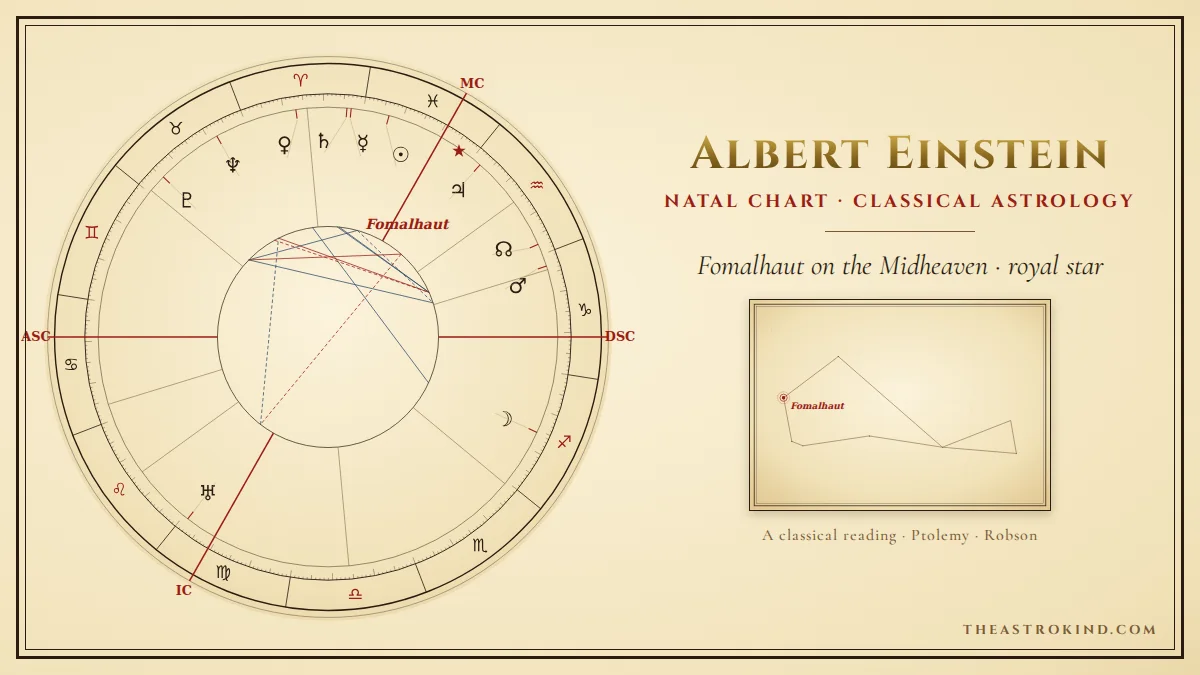
When I first cast Albert Einstein's chart using the Swiss Ephemeris, I expected a spectacular configuration. Instead, I found a chart that is almost entirely peregrine—planets without essential dignity, wandering in the zodiac. Yet this very ordinariness, combined with precise fixed-star contacts and a diurnal sect, produced one of history's most revolutionary minds. In my thirty years of practice, I have learned that genius often hides in the details, not in the obvious.
The Solar Foundation: Sun in Pisces, House 10
Einstein's Sun at 23° Pisces sits in the 10th house of career and public standing. According to Morin's Theorem 22, the Sun operates under the nature of Pisces—a watery, mutable sign—but the 10th house is a terrestrial sector, not a sign. This distinction matters: the Sun's expression is filtered through Piscean imagination and compassion, yet its arena is worldly achievement. The Sun is peregrine (Theorem 78), meaning it has no essential dignity, neither exalted nor debilitated. It relies entirely on accidental strength.
Here is the key: the Sun is the Almuten Figuris, the overall ruler of the chart. This gives Einstein a core identity rooted in the 10th house—his public role, his profession, his legacy. The Sun rules the 3rd house (communication, learning, short journeys) and sits in the 10th. Morin's Theorem 62/63 describes a causal bridge: the affairs of the 3rd house (writing, teaching, publishing) act as the origin of his 10th-house eminence. Indeed, Einstein's fame came not from laboratory experiments but from published papers—his 1905 annus mirabilis—and his relentless correspondence.
The Sun is also conjunct the fixed star Matar (orb 0.54°), which Robson describes as "good fortune from heaven, success through intellectual capacity." This is a direct, precise contact. Matar is associated with rain and abundance—a fitting image for a mind that poured forth revolutionary ideas. Additionally, the Sun sextiles Pluto (orb 1.23°) and Mars (orb 3.41°), integrating the 10th house with the 8th and 11th, linking his career to hidden forces and collective ideals.
The Lunar Sect and the Ascendant
This is a diurnal chart—the Sun is above the horizon, so the sect light is the Sun, not the Moon. The Ascendant is 8° Cancer, ruled by the Moon, which sits in Sagittarius in the 6th house. The Moon is peregrine (Theorem 78) and rules the 1st and 2nd houses. Morin's Theorem 65 states that when the ruler of the Ascendant is in the 6th house, the native's vital energy is directed toward 6th-house matters: work, service, health, and daily routines. Einstein's life was indeed one of relentless intellectual labor—not the flashy kind, but the daily grind of theoretical physics.
The Moon trines Venus (orb 2.57°), a flowing aspect between the 6th and 11th houses. This softened his work with moments of pleasure and friendship, though Venus is in exile in Aries (Theorem 38/69), so those benefits came with difficulty. The Moon also rules the 2nd house of resources, and its placement in the 6th suggests that his income came through his daily work—patents, lectures, and later, his professorship.
The Ascendant is conjunct several fixed stars: Bellatrix (orb 1.68°), Mebsuta (orb 3.87°), Castor (orb 4.25°), and Pollux (orb 6.21°). Bellatrix gives "great military honors, sudden disgrace, adventurous spirit, sharp cunning." Castor grants "great intellect, academic and scientific success, but sudden ups and downs." Pollux adds "intrepid courage, audacity, and a warrior character." These stars paint a portrait of a bold, intellectually fierce individual who faced abrupt reversals—exactly Einstein's trajectory from patent clerk to global icon.
The Mercurial Engine: Mercury and Saturn in the 10th
Mercury, the planet of intellect, is in Aries in the 10th house, conjunct Saturn (orb 1.06°). Mercury is peregrine, but its conjunction with Saturn is a powerful signature. Saturn is in fall in Aries (Theorem 38/69), which impedes the advantages of the 10th house or realizes them with severe difficulties. This is the chart of a man whose career was marked by struggle, rejection, and eventual vindication. Saturn rules the 7th, 8th, and 9th houses, and its placement in the 10th means that partnerships (7th), shared resources (8th), and higher learning (9th) are causally linked to his public standing.
Mercury is also in a partile sextile with the North Node (Caput Draconis) in Aquarius in the 8th house (orb 0.39°). Morin's Theorem 101 gives this aspect absolute preeminence. It integrates the 10th house of career with the 8th house of hidden knowledge, transformation, and legacy. Einstein's revolutionary theories were not just intellectual exercises; they transformed our understanding of reality itself. The North Node is conjunct the fixed stars Dabih, Giedi, and Bos—all associated with sacrifice, patience, and slow, steady labor. This is the signature of a man who worked quietly for years before his breakthrough.
Saturn also sextiles the North Node (orb 1.46°), reinforcing the connection between his career and the 8th house. And Saturn is the ruler of the 8th house, so its placement in the 10th (Theorem 70) links risk and finitude to his public role. Einstein's work on the atomic bomb—and his later pacifism—reflects this tension.
The Fixed Stars of the Midheaven
The Midheaven at 9° Pisces is conjunct a cluster of fixed stars: Skat (orb 1.14°), Matar (orb 1.58°), Fomalhaut (orb 1.82°), Homam (orb 2.06°), and Scheat (orb 3.56°). Skat gives "good fortune, lasting happiness, prudence, and psychic sensitivity." Fomalhaut, one of the four Royal Stars, is the "Guardian of the South" and grants "great fame, spiritual depth, and immortality in legacy." This is the star of a man whose name is synonymous with genius. Homam adds "valor, activity, and speed." But Scheat warns of "great sensitivity, prophetic intuition, and tragedies related to water or great losses." Einstein's life was marked by personal losses—his daughter Lieserl, his first marriage—and the global tragedy of the atomic age.
The Midheaven also conjuncts Matar, reinforcing the Sun's contact. This double emphasis on Matar—Sun and MC—is extraordinary. It confirms that his intellectual success was not accidental but written into the fabric of his chart.
The Almuten and the Lord of the Year
The Almuten Figuris is the Sun, as we have seen. But the Ptolemaic Lord of the Year is Venus, which is in exile in Aries in the 11th house. Venus rules the 5th and 12th houses, and its placement in the 11th links creativity (5th) and hidden matters (12th) to his hopes and friendships (11th). Venus is also the author of misfortune (Rule 12/69) when connected to the 12th, suggesting that his social circle and ideals were both a source of strength and isolation. Einstein's pacifism and Zionist activism brought him both admiration and enemies.
Practical takeaway
- Peregrine planets are not weak—they rely on fixed stars and angular placements. Einstein's Sun and Mercury, though peregrine, are elevated by Matar and the 10th house.
- The Almuten Figuris reveals the core identity. Here, the Sun in the 10th shows a life defined by public intellectual achievement.
- Fixed stars add precision. The conjunctions to the Sun, MC, and Ascendant are tight and descriptive, not vague.
- Morin's causal bridges explain life themes. The 3rd house (writing) causing 10th house (fame) is a textbook example.