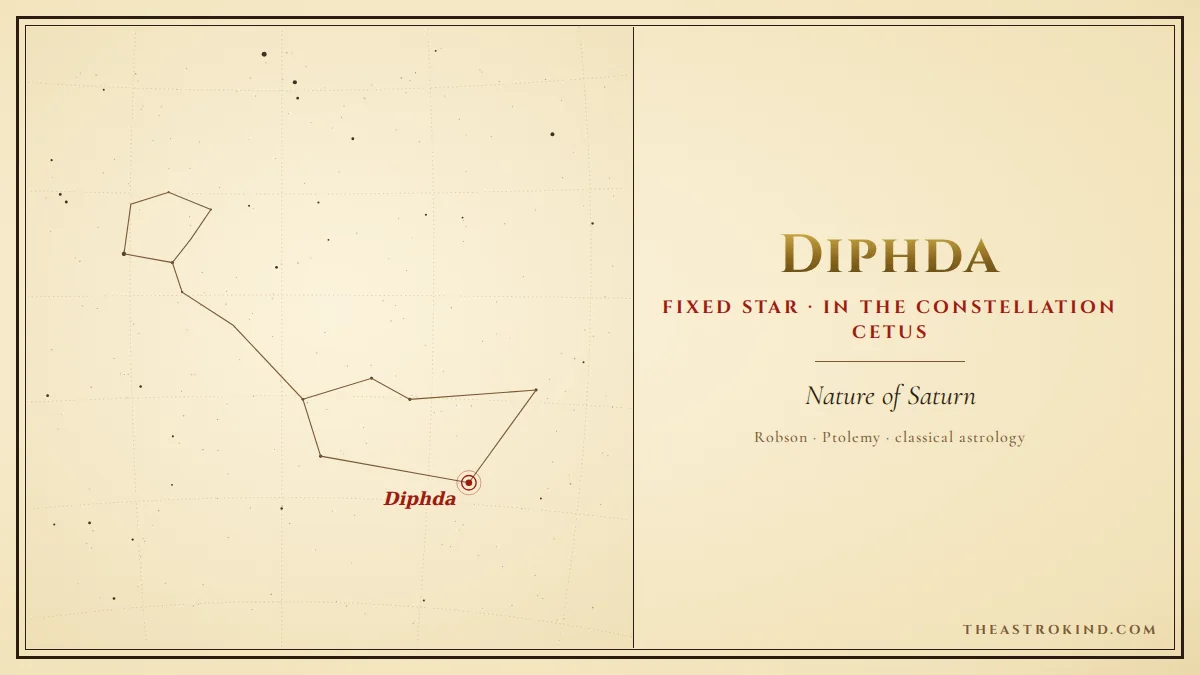
Diphda (β Ceti), also known as Deneb Kaitos, is a fixed star of the second magnitude in the constellation Cetus, the Sea Monster. In the classical tradition, it is considered to be of the nature of Saturn, a planet of limitation, discipline, and inevitable consequence. When prominent in a natal chart, Diphda demands careful judgment, for its influence is rarely gentle.
What is Diphda and why does it matter?
Diphda is the brightest star in Cetus, marking the tail of the sea monster. Its name derives from the Arabic Al Dhanab al Ḳaiṭos, “the tail of the whale.” In Ptolemy’s Tetrabiblos, the stars of Cetus are associated with Saturn, and later authors such as Vivian Robson in Fixed Stars and Constellations in Astrology codified its influence: “Self-destruction through brute force, sickness, disgrace, misfortune and compulsory change. Similar to Deneb Kaitos.”
This is a star that does not flatter. It speaks of situations where force—physical, emotional, or circumstantial—meets an immovable obstacle. The result is often a forced transformation, a stripping away of what cannot endure. In my thirty years of practice, I have seen Diphda act as a catalyst for profound change, rarely welcomed by the native at the time.
The Saturnine nature of Diphda
Saturn’s nature is cold, dry, and malefic in the classical sense—not evil, but harsh and disciplinary. Diphda channels this through the image of the sea monster: the brute, instinctual forces of nature that must be confronted. Where Saturn alone might bring slow restriction, Diphda adds an element of violence or suddenness. The sickness it indicates is often chronic or debilitating, the disgrace public, the change compulsory.
Yet Saturn also grants endurance, structure, and hard-won wisdom. Those who work with Diphda’s energy consciously can transmute its destructive potential into resilience. The key lies in recognizing where the star falls in the chart and which planets it touches.
Diphda on the angles
When Diphda is conjunct an angle—the Ascendant, Midheaven, Descendant, or Imum Coeli—its influence becomes immediately visible in the native’s life and character. On the Ascendant, it may mark a person who faces repeated crises of identity or health, often through their own stubbornness or brute force. The body may be prone to ailments related to Saturn: bones, teeth, skin, or chronic conditions.
On the Midheaven, Diphda can indicate a career marked by sudden reversals, public disgrace, or compulsory changes in status. The native may achieve prominence only to lose it through force of circumstance or their own actions. The Descendant brings these themes into partnerships: relationships that end abruptly or involve power struggles. The Imum Coeli suggests upheaval in the home or family, often through ancestral patterns of misfortune.
Diphda conjunct planets
The planet conjunct Diphda shows where the star’s influence is most acute. With the Sun, it may indicate a life of struggle against external forces, with periods of sickness or disgrace. The Moon brings emotional turbulence and compulsory changes in domestic life. Mercury can signify disputes, slander, or mental stress, while Venus may bring difficulties in love and finances, often through excess or force.
Mars conjunct Diphda is particularly potent: it amplifies the theme of brute force and self-destruction. The native may be accident-prone or inclined to violence, either as perpetrator or victim. Jupiter’s influence is more subtle, offering protection through wisdom and moderation, but still requiring conscious effort to avoid misfortune. Saturn conjunct Diphda doubles the Saturnine effect, emphasizing chronic illness, hardship, and the need for discipline.
With Uranus, Neptune, or Pluto—outer planets not known to the ancients—Diphda can manifest as sudden upheavals, illusions leading to disgrace, or deep psychological transformation through crisis. Robson’s description of “compulsory change” is especially apt here.
How to judge Diphda in a chart
First, determine the star’s position by conjunction (within 1–2 degrees, allowing for the star’s magnitude). Use a reliable fixed star calculator. Then assess the planet or angle involved, its dignity, and its aspects. A well-dignified planet can mitigate Diphda’s severity, channeling its force into productive ends. A debilitated planet may exacerbate it.
Consider the houses ruled by the conjunct planet and the houses it occupies. These areas of life will be subject to Diphda’s compulsory changes. Also examine transits and progressions to Diphda’s position, as these often time events of forced transformation.
Finally, remember that fixed stars are not fatalistic. They describe conditions, not inevitable outcomes. The native’s awareness and response can alter the manifestation. As Morin wrote in Astrologia Gallica, the stars incline but do not compel.
In practice
- Identify the conjunction: Use an accurate fixed star calculator to find Diphda’s position and any planets or angles within 1–2 degrees.
- Assess the planet’s condition: A dignified planet can redirect Diphda’s force; a debilitated one may intensify its challenges.
- Watch transits: Major transits to Diphda’s degree often coincide with compulsory changes or crises.
- Counsel caution: Advise clients to avoid brute force and to cultivate patience, for Diphda’s lessons are learned through endurance.
→ Calculate your fixed stars with our fixed stars calculator