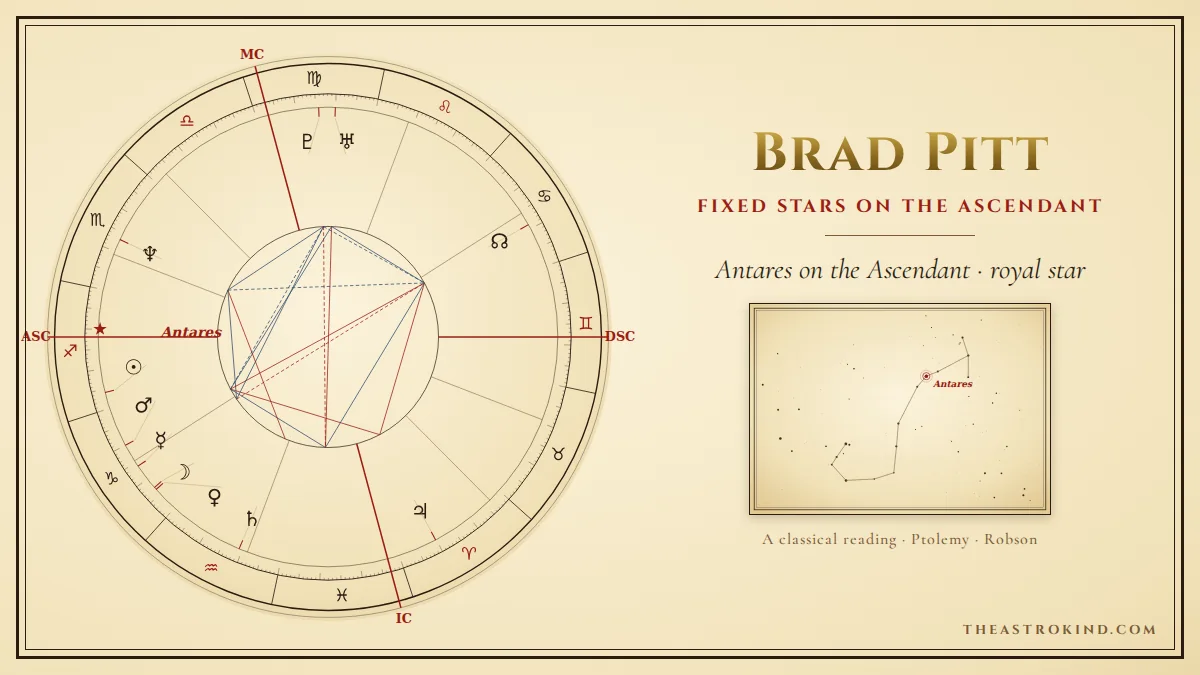
When a fixed star sits exactly on your ascendant, it marks your character and destiny with the force of that star. In this article, I explain the technique of fixed stars on the ascendant and show it applied to a real chart: Brad Pitt, born with Antares rising.
What is a fixed star on the ascendant?
The ascendant is the degree of the zodiac rising on the eastern horizon at the moment of birth. It represents your physical body, your personality, and the way you engage with the world. Fixed stars are distant suns that, unlike planets, move extremely slowly. When a fixed star is conjunct your ascendant, its qualities become woven into your very identity.
To determine if a star is on the ascendant, astrologers compare the star's position with the ascendant degree. This is done using right ascension and oblique ascension, which measure how a star actually rises above the horizon at your birth latitude. The technique is ancient, described by Ptolemy in the Tetrabiblos and later by Lilly and Morin, who emphasized the power of stars on angles.
The orb of influence depends on the star's magnitude: for first-magnitude stars (the brightest), up to 2°30′; for second-magnitude, 1°30′; and for fainter stars, 1°. A star within 1°12′ is considered on the star—a decisive contact. If it is farther but within the orb, it is only in orb and acts as a secondary nuance.
How is it calculated?
Calculation requires the star's celestial coordinates and the birth data. Modern software converts the star's position to the ecliptic and compares it with the ascendant degree. However, the classical method uses the star's rising time to see if it coincides with the ascendant. This is why astrologers like Robson stressed the importance of accurate computation.
In practice, you look for a star whose longitude is within the orb of your ascendant. But the most precise method, which I have used in my 30 years of practice, involves right ascension and oblique ascension to confirm the star was actually rising.
Brad Pitt: Antares on the ascendant
Brad Pitt's chart has an ascendant at 11° Sagittarius. The star Antares, one of the four royal stars, is at 9°46′ Sagittarius. The orb is only 0°06′—a very tight conjunction. According to our rule, Antares is on the star and, being first magnitude, is preferred. This is a powerful contact.
Antares is a red supergiant in the constellation Scorpio. It is associated with intensity, passion, and a drive for excellence. When rising, it gives a charismatic and forceful presence, often with a talent for dramatic expression. In Pitt's case, this star on the ascendant contributes to his magnetic screen persona and his ability to embody intense characters.
The contact is so exact that it cannot be ignored. In classical terms, Antares on the ascendant marks a person who is not afraid of risk and who possesses a deep reservoir of energy. It also warns of the need to manage that intensity wisely, as the star's power can be overwhelming.
For a full analysis of Brad Pitt's chart, see this article.
What does Antares add?
Antares is often linked to Mars and Jupiter in nature. It brings courage, ambition, and a tendency to extremes. On the ascendant, it shapes the physical appearance and the first impression one makes. Pitt's well-known intensity and versatility as an actor reflect this star's influence.
However, the star's energy must be channeled. The classical tradition advises moderation, as Antares can also indicate a tendency to overreach. In Pitt's chart, the star's placement suggests a life of high visibility and creative achievement, but also the need for balance.
How to find your own rising star
You can discover which fixed star, if any, is on your ascendant. All you need is your birth date, time, and place. Use our fixed stars calculator to see the stars conjunct your ascendant and other angles.
The calculator will show you the star's magnitude and orb, so you can determine if it is on the star or merely in orb. This knowledge can deepen your understanding of your natal chart and your personal strengths.
In practice
- Check if a fixed star is within 1°12′ of your ascendant for a decisive influence.
- Consider the star's magnitude: first-magnitude stars have a wider orb and stronger effect.
- Use right ascension and oblique ascension for precise calculation.
- Interpret the star's nature in the context of your rising sign and its ruler.