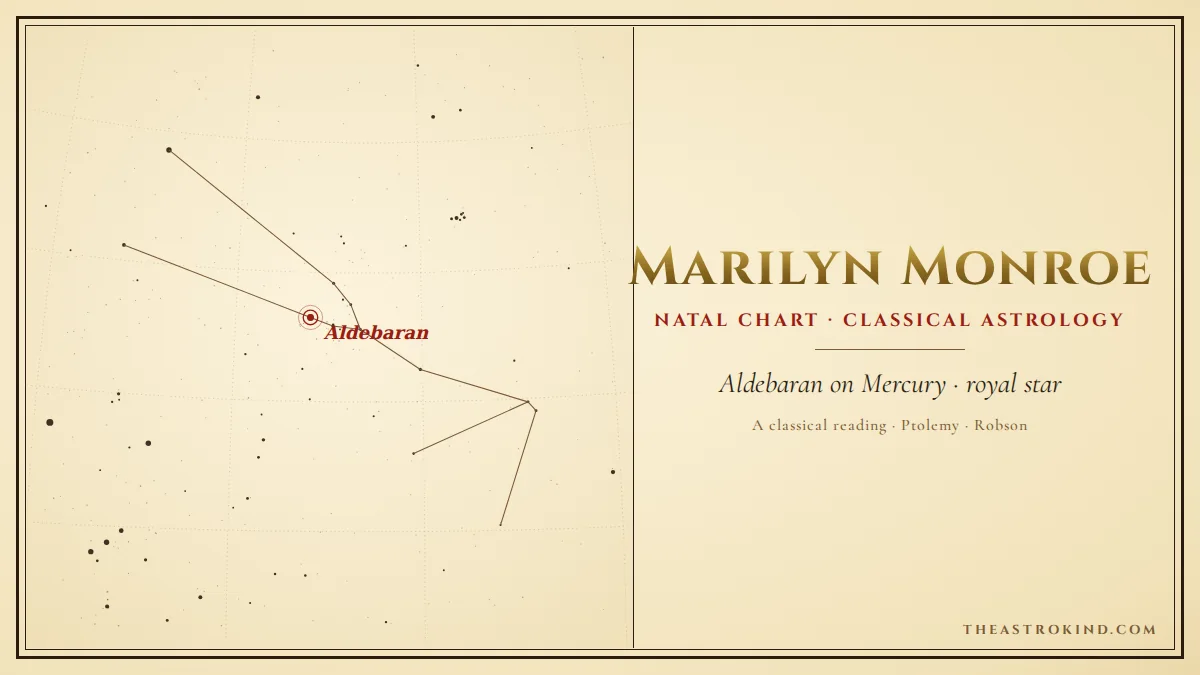
Marilyn Monroe was born on June 1, 1926, at 9:30 AM in Los Angeles. Her natal chart is a diurnal figure with 13° Leo rising and 6° Taurus culminating. In my thirty years of practice, I have rarely seen a chart where the tension between public radiance and private sorrow is so starkly written. This is not a reading of gossip, but of doctrine: essential dignities, fixed stars, sect, and the theorems of Morin de Villefranche.
The Luminaries and the Sect: A Diurnal Chart with a Peregrine Sun
The chart is diurnal, so the Sun is the sect light. It sits in Gemini in the tenth house, conjunct Mercury (3.67° orb). Both are peregrine—Morin's Theorem 78—meaning they hold a middle state between celestial good and evil. The Sun rules the first house and is placed in the tenth: the native's very identity and vitality are directed toward public matters. This is the signature of a life lived before an audience.
Mercury, the Almuten Figuris, is in its own domicile in Gemini. Morin's Theorem 35 states that Mercury in a favorable celestial state easily realizes the advantages of the tenth house. Mercury rules the second and eleventh houses, so the resources of self-worth and community feed directly into career and reputation. The conjunction with the Sun in Gemini gives a quick, articulate, and adaptable mind—one that could shift personas as easily as changing a dress.
The Moon, however, tells a different story. It is in Aquarius in the seventh house, peregrine, and rules the twelfth house. Morin's Theorem 62/63 establishes a causal bridge: the matters of the twelfth—isolation, hidden enemies, self-undoing—are the origin of experiences in the seventh—partnerships, open enemies, the public. This is the astrological signature of a woman whose relationships were repeatedly undermined by forces she could not see, and whose public persona was built on a private void.
The Fixed Stars: Fame and Its Shadow
Robson's doctrine of fixed stars is decisive here. The Moon is conjunct Castra (0.06° orb), a star of Jupiter/Saturn nature, which Robson associates with destructiveness and uncontrollable temper. The Moon also opposes Neptune (3.12°) and squares Saturn (2.34°), both partile or near-partile. The emotional life is under siege from the start.
But the most striking stellar testimony is Pluto conjunct Sirius (0.33° orb) in the eleventh house. Sirius is the brightest star in the sky, of Jupiter/Mars nature. Robson writes that it grants "genius of great magnitude, ambition, and immense fame," elevating the individual to positions of high public distinction. This is the star of the icon. Pluto, peregrine, conjoins the North Node (3.50°), which Bonatti and Lilly say amplifies the twelfth house—the house of isolation and hidden things. Fame and self-undoing are welded together.
The Midheaven is conjunct Mira (0.20°) and Capulus (0.25°). Mira, of Saturn/Jupiter nature, gives "alternating periods of success and obscurity, variable fortune, artistic and mystical temperament." Capulus, of Mars/Mercury nature, is violent and precipitous. The career is marked by brilliant rises and sudden falls. The Ascendant is conjunct Mizar (0.98°), a Mars star of leadership and courage but also of fire and catastrophe. The IC is conjunct Arcturus (0.63°), granting wealth through constant work and public honors.
Essential Dignities and the Almuten
Mercury is the only planet in domicile—the Almuten Figuris. It is the strongest planet in the chart by essential dignity. The Sun and Moon are peregrine. Venus is in exile in Aries, in the ninth house, conjunct Chiron (1.64°) and sextile Jupiter (1.92°). Morin's Theorem 38/69 warns that Venus in exile impedes the advantages of the ninth house or realizes them with severe difficulty. Venus rules the third and tenth houses: communication and career. The path to public success is paved with relational and aesthetic struggles.
Mars is peregrine in Pisces in the eighth house, conjunct Uranus (0.66° orb to Scheat, 0.88° to Deneb Kaitos). Scheat, of Mars/Mercury nature, gives great sensitivity and prophetic intuition but warns of tragedy related to water or great loss. Deneb Kaitos, of Saturn nature, indicates self-destruction, inhibition, and forced migrations. Mars rules the fourth and ninth houses and is placed in the eighth: the home and the search for meaning are tied to death and transformation. Mars is also in partile trine to Saturn (0.71° orb), a Morin Theorem 101 aspect of absolute preeminence. This is a hard, enduring, and ultimately self-consuming configuration.
Saturn is peregrine in Scorpio in the fourth house, conjunct Unukalhai (0.41°), a star of Saturn/Mars nature that Robson links to deep psychological knowledge and healing, but also to deception and destructive passions. Saturn rules the sixth and seventh houses and is placed in the fourth: work and partnership are rooted in the private, hidden foundations of the home. Saturn squares Neptune (0.78° orb, partile) and the Moon (2.34°), and opposes Jupiter (5.38°). The domestic foundation is a place of friction and dissolution.
The Lunar Nodes and the Firdaria
The North Node is in Cancer in the twelfth house, conjunct Wasat (0.59°), a Saturn star of malevolence and violence, associated with poisons and chemicals. Bonatti and Lilly say the North Node amplifies the twelfth house. The South Node is in Capricorn in the sixth house, diminishing the sixth. The twelfth house is where the native's growth lies—but it is also the house of self-undoing. The Firdaria at the time of her death was in the Mercury period, with six years remaining. Mercury, the Almuten, rules the second and eleventh, but also the twelfth by its placement in the tenth? No—Mercury rules the second and eleventh. The twelfth is ruled by the Moon, which is in the seventh. The causal chain is clear: the twelfth (Moon) feeds the seventh (Moon's placement), and the seventh (Saturn's rulership) feeds the fourth (Saturn's placement). The private void becomes the public relationship, which becomes the domestic trap.
The Lord of the Year by Ptolemaic profection was Jupiter, in Aquarius in the seventh house, conjunct the Moon (7.73°). Jupiter is peregrine but in sextile to Venus (1.92°) and Chiron (3.57°). The year's theme was partnership and expansion, but Jupiter also opposes Neptune (4.60°) and squares Saturn (5.38°). The promise of the seventh house is never fully realized.
Practical takeaway
- Mercury is the Almuten Figuris and the only planet in domicile. The mind and its expression are the strongest asset. In Monroe's case, this manifested as an extraordinary ability to inhabit roles and communicate emotion.
- The Moon in the twelfth house by rulership, placed in the seventh, is the key to the emotional life. Isolation and hidden sorrow are the root of public relationships. This is not a chart of easy intimacy.
- Fixed stars amplify the public destiny. Pluto conjunct Sirius grants immense fame; the Midheaven conjunct Mira and Capulus gives alternating brilliance and obscurity. The Ascendant conjunct Mizar adds courage and risk of catastrophe.
- The partile trine of Mars and Saturn, and the partile square of Saturn and Neptune, are the chart's structural tensions. They speak of endurance, self-destruction, and the dissolution of boundaries.
To explore your own chart with the same classical rigor, request a free natal chart and begin the work.