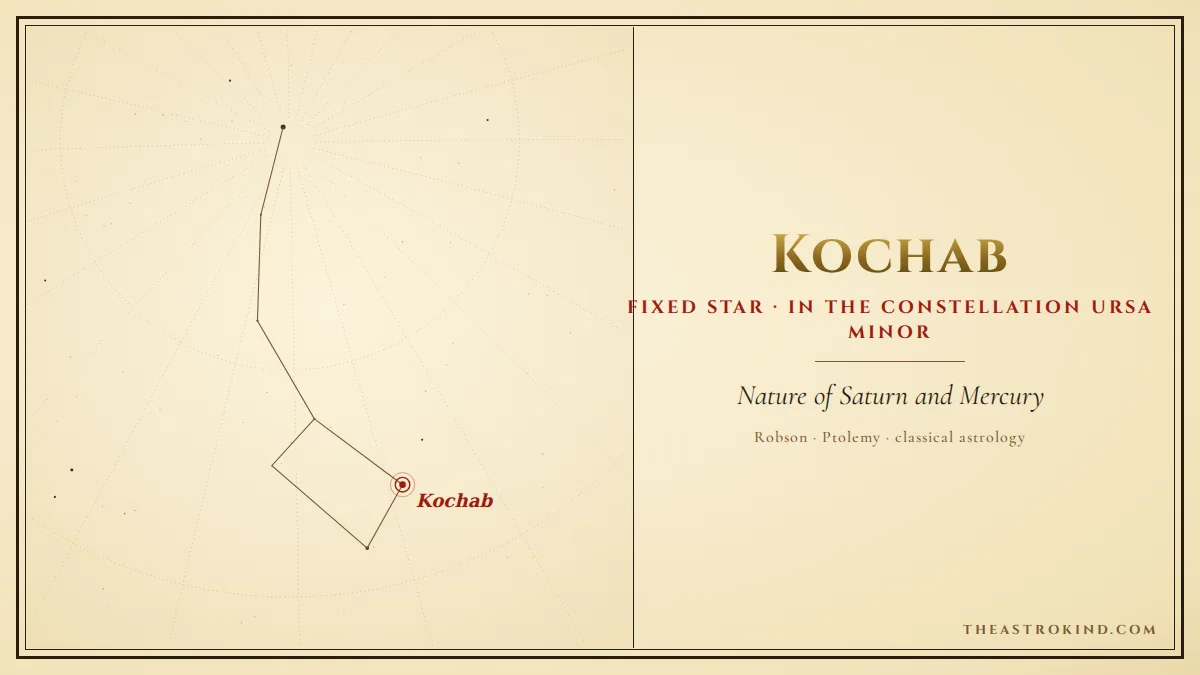
Kochab is the second-brightest star in Ursa Minor, the Little Bear, and one of the two Guardians of the Pole. It is a star of magnitude 2.1, of the nature of Saturn and Mercury. In the natal chart, Kochab does not grant easy gifts. It grants a mind that cuts, and a life that often feels the weight of that cutting. If you have Kochab prominent, you know what it is to think too much and to worry too well.
What Kochab Means in the Natal Chart
Vivian Robson, in his Fixed Stars and Constellations in Astrology, gives the classic judgment: “Analytic and penetrating mind, ability in commerce but worry and anxiety. Loss through fraud.” That sentence is the whole doctrine in miniature. The Saturnine half gives gravity, patience, suspicion, and a tendency to carry burdens that are not entirely yours. The Mercurial half gives calculation, speech, and skill in trade.
In my own practice, I have observed that Kochab is rarely loud. It does not produce the dramatic falls of Algol or the sudden elevation of Regulus. It produces a slow, grinding pressure on the mind. Natives with Kochab prominent are often excellent at analysis and poor at relaxation. They see the flaw in every plan, including their own.
The star sits at about 13° of Leo in the tropical zodiac (the exact position shifts with precession and should be checked for your epoch). It is not one of the 15 Behenian stars, so it has no traditional talisman or special image in the medieval corpus. Its authority comes from its magnitude, its position near the pole, and the testimony of authors like Robson and Ebertin.
Kochab on the Angles
When Kochab is conjunct the Ascendant, the Saturn-Mercury nature enters the body and the temperament. The native appears serious, watchful, and mentally quick. There is often a history of early responsibility or a family atmosphere of worry. The danger is a kind of corrosive self-scrutiny that undermines confidence.
On the Midheaven, Kochab marks a career built on analysis, commerce, or administration. The native may do well in trade, accounting, law, or any field that rewards suspicion and precision. But the same star warns of loss through fraud — not necessarily as victim, sometimes as the one who trusted the wrong partner. Contracts deserve a second reading.
On the Descendant, the star falls on the seventh house and describes partners who are mentally sharp and perhaps anxious, or a marriage that carries financial worry. On the Imum Coeli, it touches the home and the end of matters: property dealings require caution, and family burdens may weigh heavily.
Kochab Conjunct a Planet
With Mercury, Kochab intensifies the analytic faculty. The mind is penetrating, skeptical, and excellent at detail. The cost is nervous strain, insomnia, and a tendency to over-calculate. With Saturn, the worry becomes structural: melancholy, isolation, and a fear of loss that can become self-fulfilling. The native must learn to distinguish prudence from paralysis.
With Venus, the star brings anxiety into relationships and money. There may be skill in commerce, especially in luxury or goods, but also a fear of scarcity. With Mars, the combination is sharper: a critical tongue, a tendency to argue, and a risk of loss through disputes or sharp practice — either suffered or committed.
With the Sun, Kochab gives a serious, responsible character with a strong sense of duty. With the Moon, it gives a worried emotional nature, often rooted in early insecurity. In both cases, the key is to give the mind a proper object: work that rewards analysis, rather than free-floating anxiety.
How to Judge Kochab Fairly
No fixed star acts alone. Robson himself insists that the star must be judged with the planet it touches, the sign, and the lord of the geniture. A well-dignified Mercury conjunct Kochab in an earthy sign can produce a fine merchant or auditor. A debilitated Saturn conjunct Kochab can produce chronic fear and loss.
Paran maps and ecliptic projections differ. Morin, in his Astrologia Gallica, was careful to distinguish the true position of stars from their aspects to planets. Use a reliable fixed star calculator and check the orb: within 1° for conjunction to an angle or planet is the classical standard; within 2° is a wider influence.
The tradition also asks whether the star is rising, culminating, setting, or on the lower meridian. A star on the angles is stronger than one in the middle of a house. Kochab near the pole is always visible in northern latitudes, which in mundane astrology gives it a quality of constancy — a burden that does not lift, but also a steadiness that does not fail.
In practice
- Check Kochab’s exact position for your epoch and confirm any conjunction within 1–2° to an angle, the Sun, Moon, or Mercury-Saturn.
- Read the star through the planet it touches: Mercury for the mind, Saturn for the burden, Venus for money and affection, Mars for conflict.
- Treat “loss through fraud” as a warning, not a fate: insist on clear contracts and verify partners.
- Give the analytic mind a disciplined outlet — commerce, research, law, or accounting — so that worry becomes work.