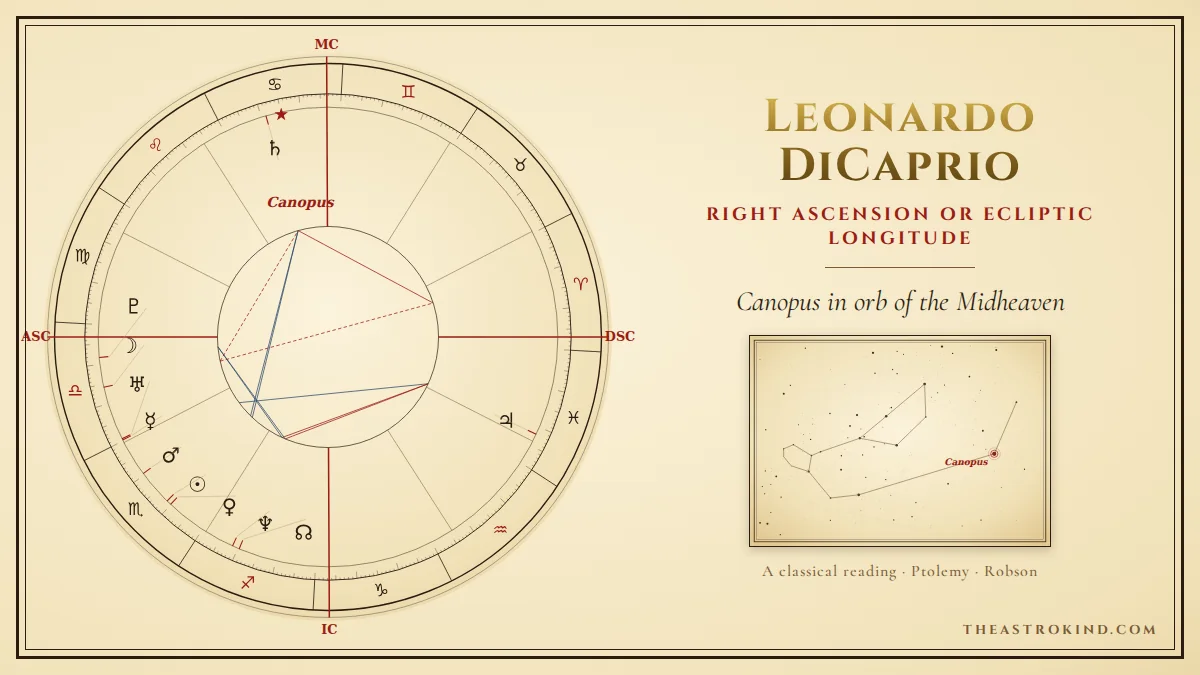
If you have ever compared fixed star reports from two different software programs, you have probably seen contradictory results. One puts a brilliant star on the Midheaven; another ignores it and highlights a different star on the Descendant. The reason is not a bug. It is a methodological choice: whether the star is measured by ecliptic longitude or by right ascension. This article explains the difference and shows why it matters, using the chart of Leonardo DiCaprio as a case study.
What is right ascension, and why does it matter for fixed stars?
Right ascension (RA) is the astronomical coordinate that tells you when a star rises and culminates. Imagine the celestial equator as a clock face: RA is the hour hand, measured in hours, minutes and seconds from the vernal equinox. Ecliptic longitude, by contrast, is the star's position along the zodiac belt, measured in degrees from 0° Aries. Both are valid coordinates, but they answer different questions.
When astrologers talk about a star being “on the Midheaven,” they mean the star is culminating at the same moment as the MC. Culmination is a function of right ascension, not ecliptic longitude. A star with the same ecliptic longitude as the MC may not actually be on the meridian. This is why the classical tradition, from Ptolemy to Morin de Villefranche, insisted on using RA for angular contacts. The fixed stars right ascension method is the only one that reflects how a star truly rises, culminates or sets.
The difference can be large. Because the ecliptic is tilted relative to the equator, a star's RA and its ecliptic longitude can diverge by many degrees. For stars near the solstitial points, the discrepancy is maximal. Using ecliptic longitude for angles is like measuring the height of a building with a ruler held at an angle: you get a number, but not the one you need.
How the calculation works
To find whether a star is on an angle, you compute the star's right ascension and declination for the date of birth. Then you compare the star's RA with the RAMC (right ascension of the Midheaven) or with the oblique ascension of the Ascendant. If the difference is within the orb, the star is considered angular. This is the method used by the best traditional software and by the fixed stars calculator on this site.
Many modern calculators, however, simply take the star's ecliptic longitude and compare it with the ecliptic longitude of the MC or Ascendant. That approach is easier to code but astronomically wrong for angles. It can produce contacts that never actually happened in the sky, and it can miss contacts that did.
Leonardo DiCaprio's chart: a clear demonstration
Leonardo DiCaprio was born on 11 November 1974 at 02:47 in Los Angeles. His Midheaven is at 3° Cancer and his Descendant at 3° Aries. Using the right ascension method, we find three star contacts that are astronomically real.
Canopus on the Midheaven. Canopus, magnitude −0.72, is the second-brightest star in the night sky. Its right ascension places it within 2°09′ of the MC, which is inside the orb for a first-magnitude star (2°30′). It is therefore in orb but not on the star (the threshold for “on the star” is 1°12′). Canopus is a star of great power in the classical tradition, associated with voyages and distant journeys. Its presence on the Midheaven, even at the edge of the orb, adds a background tone of far-reaching influence.
Propus on the Midheaven. Propus, magnitude 3.3, is a third-magnitude star. Its orb allowance is only 1°, and its right ascension is just 0°22′ from the MC. That is well within 1°12′, so Propus is on the star. This is a decisive contact. Propus is a star in Gemini, traditionally linked to suffering and endurance, but also to the ability to hold on and prevail. On the Midheaven, it marks a career that involves struggle and persistence, often in the public eye.
Matar on the Descendant. Matar, magnitude 2.9, is a second-magnitude star. Its orb allowance is 1°30′, and its oblique ascension is only 0°13′ from the Descendant. That makes it on the star. Matar is associated with ambition and the drive for recognition, sometimes at a cost. On the Descendant, it describes partners and open enemies who are ambitious and competitive.
Now compare this with the ecliptic projection method. That approach would show Diphda on the Descendant, Kaus Australis on the Imum Coeli, and Kaus Media on the Imum Coeli. But those stars are not actually rising or culminating at the moment of birth. They are ecliptic ghosts. Meanwhile, the projection method would miss Canopus on the Midheaven and Matar on the Descendant entirely. The difference is not subtle: it changes which stars are considered angular.
Why the right ascension method is more reliable
The right ascension method is not a modern invention. It is the method used by Ptolemy in the Tetrabiblos and by Morin de Villefranche in his Astrologia Gallica. These authors understood that the angles are astronomical phenomena, not abstract zodiacal points. When they spoke of a star being “on the Midheaven,” they meant it was culminating. The fixed stars right ascension approach is therefore the traditional one, and it is the one that gives consistent results across different charts.
In my own practice, I have seen many cases where a client's chart seemed to lack angular fixed stars until we recalculated using RA. Suddenly, a bright star appeared on the Ascendant or MC, and the chart made sense. The technique is not esoteric; it is simply correct astronomy applied to astrology.
How to check your own chart
You do not need to be a mathematician to use this method. The fixed stars calculator on this site does the heavy lifting for you. Enter your birth data, and it will show you which stars are on your angles using right ascension. You can then compare the results with any other software you use. If you see a difference, you will know why.
For a full interpretation of Leonardo DiCaprio's chart, including the planetary placements and houses, see the complete article here.
In practice
- Always check whether a fixed star calculator uses right ascension or ecliptic longitude for angles. The difference can change your interpretation.
- Use the orb rule: a star within 1°12′ of an angle is on the star and should be given full weight; a star farther out but within its magnitude orb is only in orb and is a secondary nuance.
- First-magnitude stars on an angle are the most powerful. Treat them first.
- If a star appears on an angle in one program but not another, calculate its right ascension manually or use a trusted tool to verify.