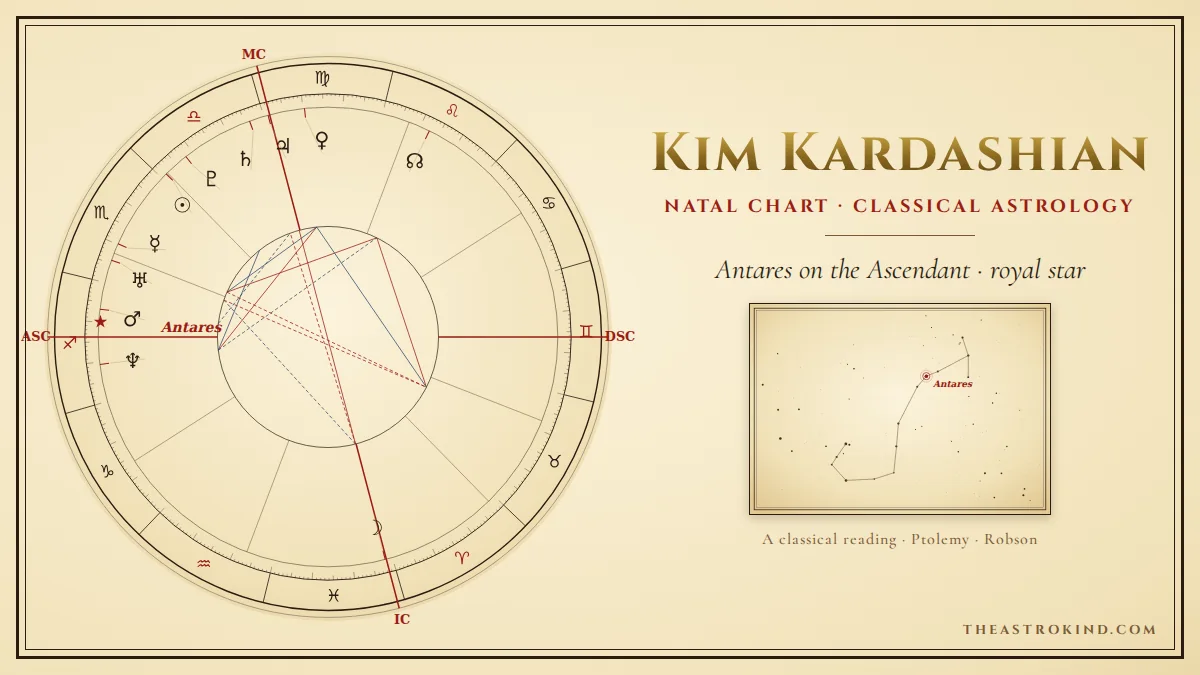
Kim Kardashian's birth data — 21 October 1980, 10:46, Los Angeles — gives a diurnal chart with 13° Sagittarius rising and 28° Virgo culminating. Read through the lens of Morin de Villefranche, William Lilly and Vivian Robson, this is not a chart of easy luck. It is a chart of enormous public reach built on a weak Sun, a peregrine Moon, and a Midheaven loaded with contradictory fixed stars. In my thirty years of practice, few nativities show such a clean split between private fragility and public empire.
The Sect, the Ascendant and the Almuten
The chart is diurnal: the Sun sits above the horizon in Libra, in the eleventh house. By sect doctrine, the Sun is the primary light and Jupiter the benefic of the sect — a favourable condition for a native whose life is lived in daylight, in full view of the collective. The Ascendant falls in Sagittarius, ruled by Jupiter, which is also lord of the fourth. Jupiter is therefore the lord of the Ascendant, and it sits in the tenth house, conjunct the Midheaven within 0.42°.
Morin's Theorem 65 is explicit: when the lord of the first is placed in the tenth, the native's vital inclinations are directed primarily toward career, reputation and authority. This is the structural signature of a life organised around public identity. The Almuten Figuris of the chart is Saturn, which reinforces the same theme — Saturn is exalted in Libra and also occupies the tenth house.
Essential Dignities: A Weak Sun, an Exalted Saturn
The Sun in Libra is in fall. Morin's Theorem 38 is unambiguous: a Sun in a state of celestial debility cannot deliver the full advantages of its house, or delivers them only through severe difficulty. The Sun rules the ninth and sits in the eleventh — so the ninth-house matters (beliefs, publishing, foreign or large-scale ventures) act as the cause of eleventh-house outcomes (networks, patrons, the public). The Sun is also conjunct Pluto in Libra, which intensifies but does not dignify it.
Saturn, by contrast, is exalted in Libra and rules the second and third houses from the tenth. Morin's Theorem 35 states that an exalted Saturn easily realises the advantages of the tenth. Here is the paradox of the chart: the Sun, the natural significator of honour, is weak, but Saturn, the slowest and most disciplined planet, is strong and angular. Fame arrives, but through structure, endurance and the monetisation of a personal brand — second-house matters (income, resources) and third-house matters (communication, media) are the causal engine of the tenth-house result.
Venus in Virgo is also in fall, in the ninth, ruling the sixth and eleventh. Jupiter in Virgo is in exile, in the tenth. Three of the traditional planets are debilitated. This is not a chart of natural ease; it is a chart that must convert weakness into strategy.
The Moon, the Nodes and the Fixed Stars
The Moon is in Pisces in the third house, peregrine — neither dignified nor debilitated, in Morin's middle state. It rules the eighth and is placed in the third, so eighth-house themes (other people's money, shared resources, crisis, transformation) are the origin of third-house experience (siblings, short journeys, media, daily communication). The Moon is conjunct the fixed star Scheat within 0.94°: Robson warns of great sensitivity and intuition, but also of loss connected to water or large reversals. The Moon opposes the Midheaven within 0.29° — a partile aspect, which Morin's Theorem 101 grants absolute preeminence. The eighth-house significations are poured directly onto the career and reputation.
The nodal axis runs across the second and eighth houses: Caput Draconis in Leo in the eighth, conjunct the star Alterf within 0.05°, and Cauda Draconis in Aquarius in the second. Bonatti and Lilly teach that the North Node amplifies the house it occupies and the South Node diminishes it. Here the eighth is amplified and the second is diminished — yet the second house is where Saturn, the chart's almuten, has its rulership. The lesson is that wealth is not accumulated passively; it is drawn through the eighth-house axis of partnership, licensing and shared enterprise.
The Tenth House and the Stars of Fame
The Midheaven at 28° Virgo carries an extraordinary stellar load. Phecda (Mars nature) is conjunct within 0.38°, and Robson associates it with excess and destructive extravagance. Zavijava (Mercury/Mars) at 1.16° gives strength of character and business capacity. Denebola (Saturn/Venus) at 1.57° grants an independent spirit and quick judgement, with a warning against haste. The Descendant, opposite, is conjunct Sirius within 0.80° — the brightest star, which Robson calls a marker of immense fame and elevation to high public distinction — and Aludra at 0.00°, which warns of scandal and defamation.
The Ascendant is conjunct Sabik (0.33°), Deneb (1.30°), Antares (1.95°) and Albireo (2.91°). Antares, a Royal Star of the West, gives colossal courage and success in struggle, with a strict warning against obsession. Deneb grants a brilliant, ingenious mind; Albireo adds beauty and charm. The combination is a public persona built on magnetism and combativeness.
Mercury in Scorpio in the eleventh is conjunct Zuben Eschamali within 0.72° — Robson's star of great ambition, political success and social distinction. Mercury rules the seventh and tenth and sits in the eleventh: partnerships and career matters are the cause of network and audience outcomes. Mercury is also sextile Venus within 0.20°, a partile aspect of fluency between the eleventh and ninth — the machinery of media, image and message.
Marte in Sagittarius in the twelfth is peregrine and conjunct Alniyat and Marfik. Morin's Rule 12/69 identifies the twelfth-house connection as a source of hidden trials and enmities. Mars rules the fifth and twelfth, so creative output and hidden matters feed each other. Mars is sextile Saturn within 3.11°, which channels that twelfth-house force into the tenth-house structure — the discipline behind the spectacle.
Profections and the Current Cycle
At age 45 the annual profection falls in Virgo, the tenth house, with Mercury as Lord of the Year. The Firdaria major period is Saturn, with six years remaining. Saturn is the almuten of the figure and exalted in the tenth: this is a period in which the career structure consolidates, but slowly and under pressure. Mercury, the year lord, is peregrine and rules the tenth — the year's results depend on communication and negotiation rather than on spontaneous fortune.
Practical takeaway
- Read the chart by sect first: diurnal, Sun above the horizon, Jupiter as sect benefic — a life lived publicly.
- Weight the dignities before the aspects: a fallen Sun and fallen Venus cannot promise ease, but an exalted Saturn in the tenth can deliver durable structure.
- Treat the partile aspects (Moon–MC, Jupiter–MC, Mercury–Venus) as the chart's spine; they override wider configurations.
- Use the fixed stars as modifiers, not causes: Sirius on the Descendant and Zuben Eschamali on Mercury describe the scale of fame; Phecda and Aludra describe its cost.
Anyone studying this nativity should begin with the same discipline: compute the dignities, locate the almuten, then let the stars speak only where the doctrine supports them.