This is a clean, apolitical astrological examination of the fixed stars in the natal chart of Alice Weidel. It takes no side, it is not an opinion for or against her or her party, and it does not predict any election. The birth time is not known with certainty; the chart uses an approximate time of 12:00 local, so we do not draw conclusions from the Ascendant, Midheaven, houses, stars on the angles, the Part of Fortune or the exact degree of the Moon. Instead, we focus on fixed-star conjunctions to the Sun and the slow planets, which hold for the whole day.
The Fixed Stars in the Natal Chart of Alice Weidel: A Methodological Note
Classical authors such as Ptolemy, Robson and Lilly treated fixed stars as secondary but potent modifiers of planetary expression. They do not act alone; they colour the planet they conjoin. In this chart, several slow planets and the Sun form tight conjunctions with stars of distinct natures. We examine each one using the orbs and natures given by Vivian Robson in his 1923 study, Fixed Stars and Constellations in Astrology.
Because the birth time is uncertain, we ignore stars on the Ascendant, Midheaven and IC, as well as the Moon's exact position. The Moon moves about 13 degrees per day, so its conjunctions are unreliable. The Sun and the outer planets, however, move slowly enough that their star contacts remain valid for the entire day.
Sun and Mars in Aquarius: The Public Signature
The Sun at 17° Aquarius is not closely conjunct any major fixed star within 1°. However, Mars at 19° Aquarius is conjunct two stars: Dorsum (orb 0.41°) and Armus (orb 0.69°). Robson describes Dorsum as having the nature of Jupiter and Saturn, promising “burdens, responsibility, patience and hard work.” Armus, of the nature of Mars and Mercury, is less flattering: “despicable character, querulous, quarrelsome.”
Mars in Aquarius in the 10th house (using the approximate time) is peregrine, meaning it has no essential dignity. The star Dorsum adds a note of heavy responsibility and endurance, while Armus introduces a combative, sharp-tongued quality. In classical terms, Mars is the author of misfortune when connected to the 12th house, which it rules here. The star contact reinforces a public style that is forceful, contentious and unyielding—traits that are evident in her political career without needing moral judgement.
Jupiter and the Star Talitha
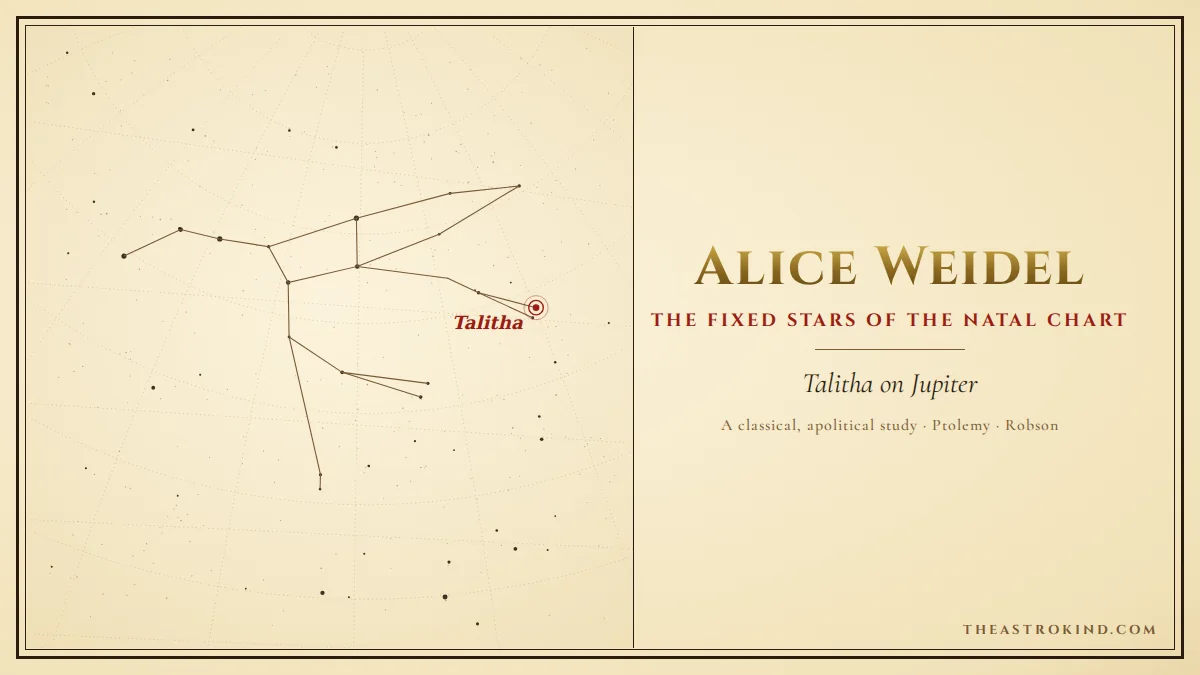
Jupiter at 7° Leo is conjunct the star Talitha (orb 0.16°), of the nature of Mars. Robson says Talitha gives a “quiet, prudent and industrious nature” but also warns of “danger.” Jupiter is peregrine in Leo, so its natural benevolence is not strong. The star adds a martial edge to Jupiter's expression: her expansion and beliefs are pursued with a quiet but determined force. In the 3rd house, this may relate to communication and local networks, but we avoid house-based conclusions due to the uncertain birth time.
Saturn and the Star Chertan
Saturn at 17° Virgo is conjunct Chertan (orb 0.81°), a star of Saturn-Venus nature. Robson describes it as giving a “skilful and cunning nature, industriousness, patience.” Saturn is peregrine in Virgo, so its expression is already cautious and methodical. Chertan reinforces these qualities, adding a strategic, calculating dimension. Saturn also rules the 8th, 9th and 10th houses by sign, but again, without a reliable birth time, we refrain from house-based predictions.
The star Chertan's Saturn-Venus blend suggests a disciplined approach to relationships and resources, with a touch of artistic or diplomatic skill. In a public figure, this might manifest as a carefully crafted image and a pragmatic, sometimes austere, political style.
Uranus and the Star Unukalhai
Uranus at 19° Scorpio is conjunct Unukalhai (orb 0.92°), of the nature of Saturn and Mars. Robson associates it with “knowledge of deep psychology” and “unusual events.” Uranus is peregrine in Scorpio, so its rebellious and innovative qualities are not essentially strong. The star adds a penetrating, investigative quality, perhaps indicating an interest in hidden matters or a talent for uncovering secrets. In public life, this could translate into a knack for tapping into underlying social currents or for disruptive strategies.
How the Stars Combine
The fixed stars in this chart do not form a harmonious chorus. Mars with Armus and Dorsum brings conflict and burden; Jupiter with Talitha adds a quiet but martial prudence; Saturn with Chertan contributes cunning and patience; Uranus with Unukalhai gives psychological insight. Together, they paint a picture of a public figure who is combative, strategic, and psychologically astute. The stars do not override the planets; they refine them. Mars is already peregrine and in a day chart, so its expression is more about effort than ease. The stars add texture: Armus sharpens the tongue, Dorsum adds weight, Talitha lends a calculating edge, Chertan reinforces discipline, and Unukalhai deepens insight.
It is important to note that the Sun, the luminary of the sect, is in exile in Aquarius and peregrine, so the chart's overall tone is one of struggle and self-made effort. The fixed stars do not change that; they highlight specific areas of friction and talent.
In Practice
- Fixed stars act as planetary modifiers, not independent agents. Always interpret them in the context of the planet's dignity and house placement.
- When the birth time is uncertain, rely on stars conjunct the Sun and slow planets; ignore stars on the angles and the Moon.
- Robson's descriptions are a useful starting point, but they must be tested against the whole chart and the native's life.
- In public figures, fixed-star conjunctions often correspond to notable character traits or recurring themes in their career.