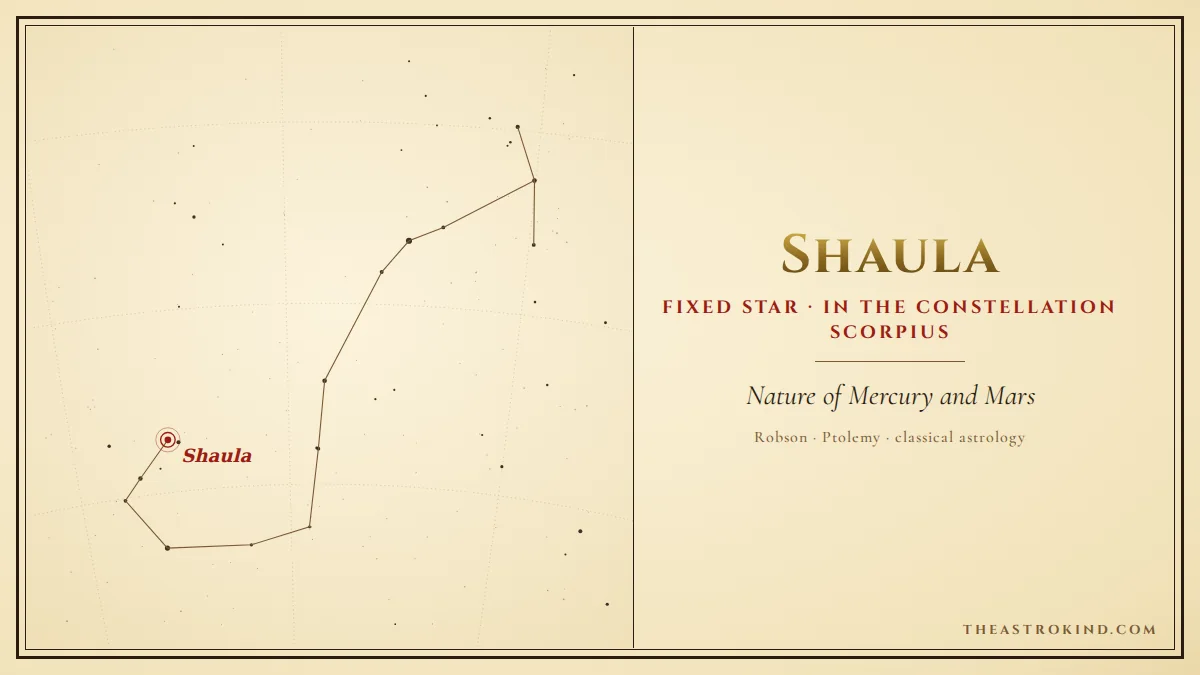
In my three decades of reading charts, few fixed stars provoke as much immediate recognition as Shaula. When it sits prominently in a natal chart, clients often describe a life punctuated by sharp turns, pointed words, and an inner fire that refuses to be tamed. Shaula, the second-magnitude star marking the stinger of Scorpius, is not a gentle influence. It is the celestial equivalent of a drawn blade—precise, penetrating, and unapologetically combative.
This article examines Shaula in the natal chart through the lens of classical astrology. We will explore its mythological roots, its traditional significations, and how to judge its effects when angular, conjunct planets, or placed in specific houses. By the end, you will have a practical framework for interpreting this potent stellar point, whether it appears in your own chart or a client's.
The Scorpion's Sting: Myth and Meaning
Shaula, from the Arabic al-shaulah, meaning 'the raised (sting),' sits at the tip of Scorpius's tail. In Greek myth, this is the scorpion sent by Gaia to slay Orion, striking the hunter with a venomous blow. Ptolemy, in the Tetrabiblos, likened stars in the tail of Scorpius to Saturn and Mars—a combination that speaks of severity, endurance, and aggressive defense. Later authorities, including Vivian Robson in Fixed Stars and Constellations in Astrology, echoed this, assigning Shaula a nature of 'Saturn-Mars' with a hint of Mercury, due to its position in the ecliptic.
This Saturn-Mars blend is crucial. It is not the hot, impulsive anger of Mars alone, but a colder, more calculated aggression. Think of a strategist who strikes only when necessary, but with devastating effect. In my practice, I have observed that Shaula natives often possess a sharp intellect and a tongue that can cut, but they also harbor deep reserves of patience. They do not start fights, but they finish them.
Shaula in the Natal Chart: Key Placements
Angular Shaula: The Sting in Action
When Shaula is conjunct the Ascendant, Midheaven, or the angles, its combative nature becomes a defining life theme. On the Ascendant, it can manifest as a piercing gaze, a direct manner, and a tendency to provoke—whether intentionally or not. These individuals often face opposition early in life, which forges a resilient, sometimes ruthless exterior. On the Midheaven, Shaula suggests a career marked by conflict or competition—surgeons, litigators, investigative journalists, or military leaders. The key is channeling the sting toward a constructive target.
I recall a client with Shaula conjunct the Midheaven who worked as a trauma surgeon. Her precision under pressure was remarkable, but her bedside manner was notoriously blunt. She had learned to use the star's edge where it served, not where it harmed. This is the classic Shaula lesson: the sting must be aimed, not swung wildly.
Shaula Conjunct Planets: A Pointed Dialogue
Conjunctions to personal planets color how the sting expresses. With the Sun, Shaula intensifies ego and willpower, often producing a proud, authoritative figure who demands respect. With the Moon, emotions become sharp and defensive; the native may build emotional armor, reacting to perceived threats with biting sarcasm. Mercury conjunct Shaula gives a razor-sharp mind, excellent for debate or satire, but prone to verbal cruelty if unchecked. Mars here doubles the combative energy, sometimes leading to accidents or injuries from sharp objects—a literal manifestation of the sting.
In classical delineation, we must also consider the condition of the planet. If Mars is debilitated or retrograde, Shaula's influence may turn inward, causing self-sabotage or chronic frustration. If Jupiter or Venus aspects, the sting can be softened, used for protection rather than attack. Always weigh the whole chart, as Bonatti advised, before pronouncing judgment.
Shaula in Houses: Where the Sting Strikes
The house position reveals the life department where Shaula's challenges and gifts unfold. In the 1st house, it colors the personality and physical appearance—often a strong, athletic build or a penetrating stare. In the 7th, it points to conflict in partnerships, sometimes attracting combative spouses or open enemies. In the 10th, as noted, it affects reputation and career. In the 12th, Shaula can indicate hidden enemies or self-undoing, but also the potential for profound psychological insight if the native learns to master their inner scorpion.
I have found that Shaula in the 8th house is particularly potent, as it rules shared resources, death, and regeneration. Here, the sting may manifest through inheritance disputes, power struggles in intimate relationships, or a near-death experience that transforms the native. The key is to recognize that Shaula's sting, like the scorpion's, is also a tool of survival and rebirth.
Judging Shaula's Effects: Classical Considerations
In traditional astrology, fixed stars are judged by their nature, magnitude, and aspects to planets and angles. Shaula's Saturn-Mars nature means it is generally malefic, but its effects are not uniformly negative. When well-placed and aspecting benefics, it can confer courage, strategic acumen, and the ability to overcome great obstacles. When afflicted, it brings danger from animals, accidents, or violence—especially in the areas of life indicated by the house and sign.
Morin, in his Astrologia Gallica, emphasized that fixed stars act through the planets they contact. Therefore, a conjunction to Venus might manifest as a sharp tongue in love, but also as a passionate, loyal partner. A conjunction to Jupiter could bring legal victories or philosophical debates, but also a tendency toward dogmatism. The astrologer must synthesize these layers, never isolating the star from its context.
Another consideration is the star's declination and latitude. Shaula lies far south of the ecliptic, which in horary and mundane astrology can signify 'southern' or 'foreign' matters. In natal work, this may incline the native toward travel or interest in distant cultures, but also to feel like an outsider. The ancient Greeks saw southern stars as 'barbarian'—foreign and potentially hostile—so Shaula can amplify a sense of being misunderstood or at odds with one's environment.
Practical Takeaway
- Identify Shaula's prominence: Check if Shaula (at about 24° Sagittarius) conjuncts an angle, a planet, or the Sun/Moon. Its power is strongest within a 1–2 degree orb.
- Assess the nature: Remember its Saturn-Mars character. Expect themes of defense, precision, and potential conflict, but also resilience and strategic depth.
- Channel the sting: Encourage natives to use Shaula's sharpness in careers or hobbies that require precision—surgery, law, editing, martial arts—rather than letting it fester as verbal or physical aggression.
- Watch for afflictions: If Shaula is in hard aspect to malefics or in the 6th, 8th, or 12th houses, advise caution with sharp objects, disputes, and hidden enemies.
Shaula is not a star to fear, but one to respect. In 30 years, I have seen it forge some of the most formidable individuals—people who, like the scorpion, are calm until provoked, then strike with unerring aim. Its gift is the ability to defend what matters, to cut through deception, and to emerge from crisis stronger. If you have Shaula prominent in your chart, you carry a double-edged blade. The question is: will you wield it with wisdom, or let it wound you?