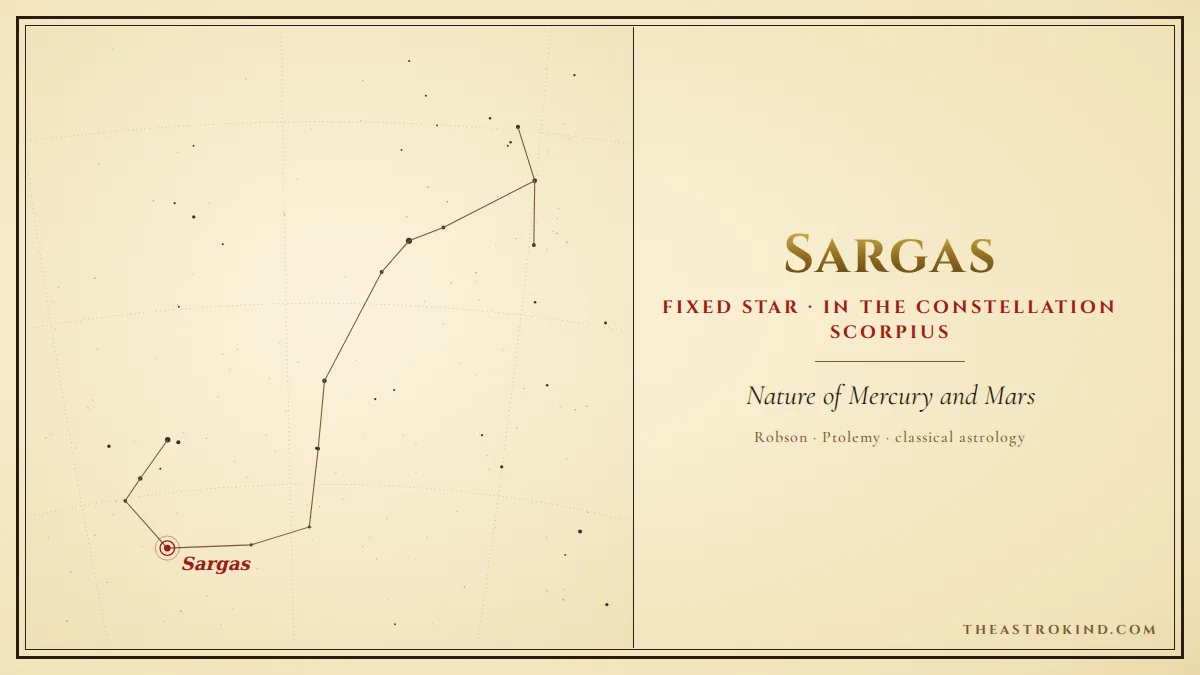
Sargas is a fixed star of magnitude 1.9 in the constellation Scorpius, positioned near the stinger of the Scorpion. In classical astrology, it is associated with the nature of Mercury and Mars, combining sharp intellect with a capacity for decisive, sometimes ruthless, action. Robson succinctly describes it as: “Connected to the stinger of the Scorpion. Danger, acute perception and a capacity for vengeance.” In this article, I will explain what it means when Sargas in the natal chart is conjunct a planet or placed on an angle, and how to interpret its influence with the precision that traditional astrology demands.
What is Sargas and why does it matter?
Sargas is one of the many fixed stars that ancient astrologers observed and incorporated into their delineations. Its position at the tail of Scorpius links it to the archetype of the scorpion: a creature that strikes swiftly and with precision when threatened. The Mercury-Mars combination gives it a dual quality: on one hand, mental acuity and strategic thinking; on the other, a propensity for conflict, sharp words, and a desire for retribution when wronged.
In natal astrology, fixed stars are not mere ornaments; they add texture and specificity to the planets they contact. As Robson notes, Sargas carries a warning of danger and a gift of perception. The key is to understand how this star operates through the planets and angles of the chart. When Sargas in the natal chart is prominent, it often indicates a person who is highly observant, quick to detect deception, and capable of acting decisively—sometimes harshly—to protect themselves or their interests.
Sargas conjunct a planet
When Sargas conjoins a planet, it infuses that planet’s expression with its Mercury-Mars signature. The orb should be tight—within 1° to 2°—to be considered significant. The planet’s own nature will determine how the star’s qualities manifest.
Conjunctions with personal planets
With Mercury, Sargas sharpens the intellect and gives a penetrating mind, but also a tendency toward sarcasm or cutting remarks. The native may have a talent for investigative work, research, or any field that requires acute analysis. With Mars, the star amplifies assertiveness and courage, but also impulsiveness and a propensity for quarrels. There is a danger of accidents or conflicts, especially if Mars is afflicted. With Venus, it can indicate intense passions and a capacity for strategic alliances, but also jealousy or possessiveness in relationships. With the Sun or Moon, Sargas may mark the native’s identity or emotional life with a constant vigilance, a sense of being under threat, or a need to control the environment.
Conjunctions with outer planets
When Sargas conjoins outer planets like Saturn, Uranus, Neptune, or Pluto, its influence is more generational but can still be felt personally if the planet is angular or heavily aspected. With Saturn, it may indicate a calculating mind and a tendency to hold grudges; with Pluto, it intensifies the capacity for power struggles and transformation through crisis. In all cases, the star adds a layer of intensity and a potential for ruthless efficiency.
Sargas on the angles
The angles of the chart—Ascendant, Midheaven, Descendant, and Imum Coeli—are the most sensitive points. When Sargas is conjunct one of these angles, its influence is immediately visible in the native’s life and character.
On the Ascendant, Sargas gives a sharp, perceptive appearance and a personality that is quick to react. The native may be seen as intense, guarded, or even intimidating. There is often a history of early challenges or a sense of having to defend oneself. On the Midheaven, the star can indicate a career involving investigation, strategy, or conflict resolution—professions like law enforcement, military, surgery, or detective work. It may also bring notoriety, but not without controversy. On the Descendant, Sargas may attract partners who are intense, perceptive, or combative, and relationships may be marked by power struggles or a need for vigilance. On the Imum Coeli, it can indicate a home environment that is secretive or fraught with tension, and a need to protect one’s private life.
How to interpret Sargas in the natal chart
Interpreting Sargas requires a balanced approach. It is not a “malefic” star per se, but it does carry a warning. Its presence in the natal chart should be assessed in the context of the entire chart. If the planet it conjoins is well-aspected and strong, Sargas can manifest as a powerful asset: acute perception, strategic thinking, and the ability to act decisively. If the planet is afflicted, the star may exacerbate tendencies toward paranoia, revenge, or conflict.
In my practice, I have observed that clients with Sargas prominent often have a history of having to defend themselves or their loved ones, and they develop a keen sense of when someone is trying to deceive them. This can be a gift, but it can also lead to isolation if they become overly suspicious. The key is to channel the Mercury-Mars energy into constructive outlets: analytical work, martial arts, or any field that requires sharp focus and quick reflexes.
It is also important to consider the constellation as a whole. Sargas is part of Scorpius, a constellation rich in symbolism. The scorpion’s sting is both a weapon and a warning: it can protect, but it can also poison. The native must learn to use their perceptiveness wisely and to avoid letting the desire for vengeance consume them.
In practice
- Check for tight conjunctions (within 1-2°) between Sargas and planets or angles; only then is its influence significant.
- Assess the condition of the planet involved: a strong, well-aspected planet channels Sargas as strategic acumen; an afflicted one may manifest as conflict or paranoia.
- Look for aspects to Mars or Mercury, as they will amplify the star’s Mercury-Mars nature.
- Consider the house placement: Sargas on an angle brings its influence into the forefront of the native’s life.