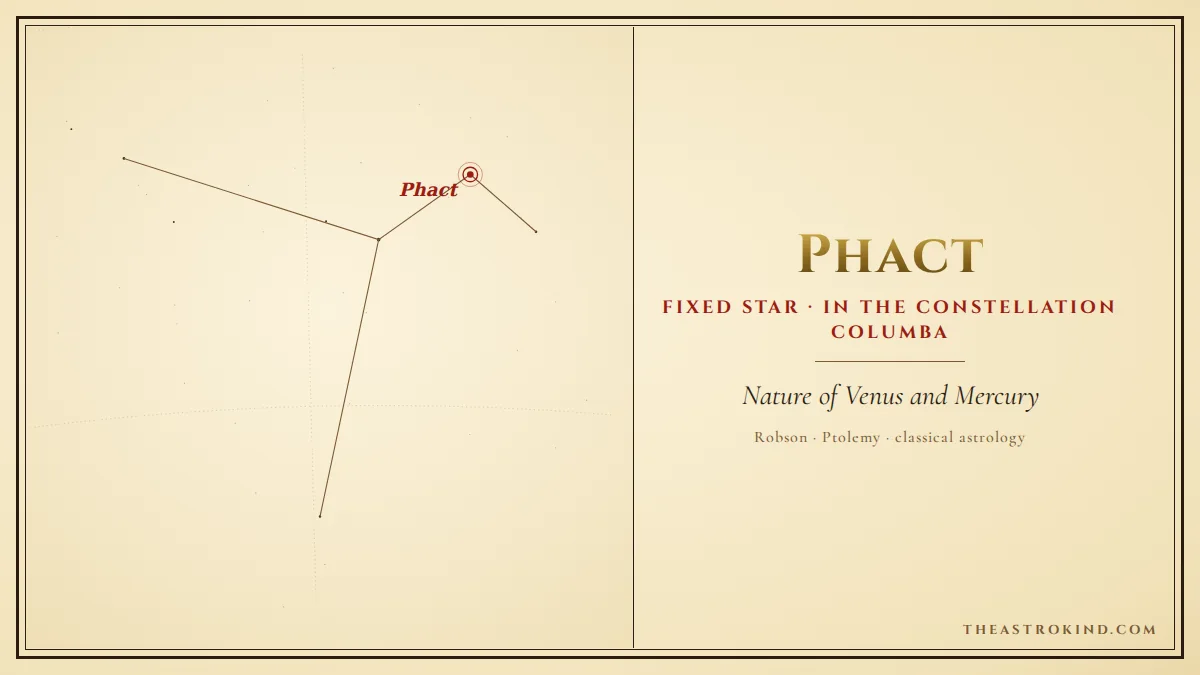
Phact (α Columbae) is a fixed star of the second magnitude in the constellation Columba, the Dove. It is of the nature of Venus and Mercury, and as Vivian Robson notes in Fixed Stars and Constellations in Astrology, it confers an “artistic and refined nature, interest in science and knowledge, beneficence.” In my three decades of practice, I have found Phact to be a gentle but distinctly civilizing influence, especially when it touches the angles or personal planets of a natal chart.
Phact in the Natal Chart: What It Signifies
Phact is not a star of sudden fame or dramatic events. Its action is subtle, persistent, and oriented toward the cultivation of taste, intellect, and humane values. It is associated with the dove, a symbol of peace and gentleness, and its Venus-Mercury combination produces a temperament that seeks harmony through knowledge and communication.
When prominent in a chart, Phact indicates a person who is naturally drawn to the arts, sciences, or any field that requires refinement of perception and expression. It does not guarantee genius, but it does incline toward curiosity, learning, and a certain elegance of mind. The benefic nature of Phact is mild; it softens harsh aspects and adds a layer of civility to the personality.
Phact on the Angles
When Phact is conjunct an angle—the Ascendant, Midheaven, Descendant, or Imum Coeli—its influence becomes more visible in the outer life. On the Ascendant, it gives a refined appearance and a courteous manner; the native may be perceived as cultured or gentle. On the Midheaven, it suggests a career or public role connected with art, science, education, or diplomacy. The Descendant may bring partners who are artistic or intellectual, while the Imum Coeli indicates a home environment that values learning and beauty.
In all cases, the key is that Phact on an angle does not create a forceful destiny; rather, it colors the native’s approach to life with grace and a desire for meaningful knowledge. It is a star of peaceable ambition.
Phact Conjunct Planets
Phact’s influence is most clearly seen when it conjuncts a planet within a degree or two. With the Sun, it adds a layer of refinement and a focus on intellectual or artistic pursuits. With the Moon, it enhances sensitivity and a love of beauty, often indicating a gentle emotional nature. Mercury receives a strong affinity, as Phact’s Mercury nature reinforces the mind’s capacity for learning and communication; it is excellent for writers, teachers, and scientists.
With Venus, Phact intensifies artistic talent and the appreciation of harmony. With Mars, it may soften the aggressive impulses and direct energy toward creative or scholarly work. Jupiter benefits from Phact’s benefic qualities, expanding the native’s interest in culture and higher knowledge. Saturn may receive a touch of refinement, making discipline more tolerable and structured around meaningful goals.
It is important to remember that fixed stars act as amplifiers or modifiers of planetary expression. Phact does not override the planet’s essential nature; it adds a Venusian-Mercurial tone—gentle, curious, and refined.
How to Interpret Phact in Practice
To assess Phact’s role in a natal chart, first locate its position. In the year 2000, Phact was at approximately 21°50′ Gemini (tropical). Because of precession, it moves about 50 seconds of arc per year, so adjust for the birth year. Use a tight orb—no more than 1° for conjunctions—to determine aspects to planets or angles.
Next, consider the planet or angle involved. A conjunction with Mercury or Venus is likely to be the most potent, as it resonates with Phact’s intrinsic nature. With the angles, observe the house and sign to see where the star’s civilizing influence is most felt. Always integrate Phact into the broader chart; it is not a standalone indicator but a subtle seasoning.
Finally, look for repeated themes. If Phact is prominent, the native may consistently seek out beauty, knowledge, and peaceful cooperation. The star’s benefic nature is rarely dramatic, but it leaves a lasting impression of refinement.
In practice
- Check if Phact is within 1° of an angle or personal planet—especially Mercury, Venus, or the Ascendant/Midheaven.
- Note the sign and house it occupies to see where its artistic or scientific interests manifest.
- Consider the star as a modifier, not a dominant force; it enhances but does not define.
- Use it to add nuance to the chart’s overall picture, particularly in matters of culture, education, and diplomacy.