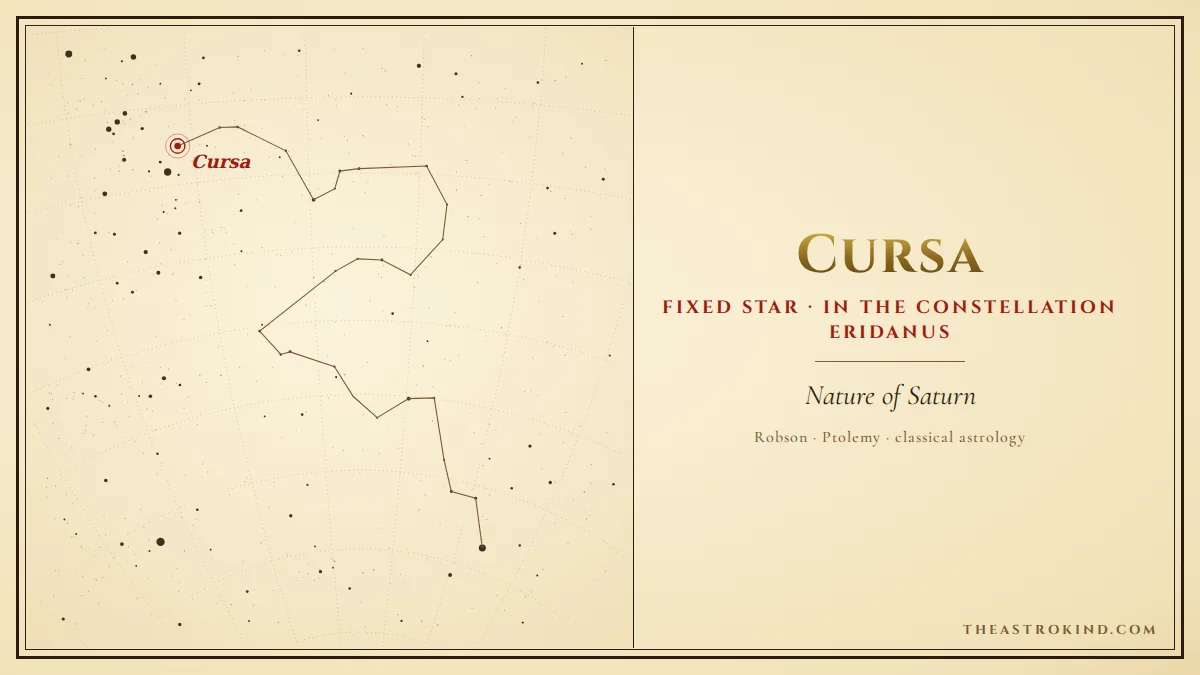
Cursa is a fixed star of the second magnitude in the constellation Eridanus, the river. In classical astrology, it is classified as Saturnian in nature, and its influence is often overlooked in modern practice. Yet when Cursa in the natal chart is prominent—especially when conjunct an angle or a planet—it can mark a life shaped by the flow of fortune, the transmission of knowledge, and the beginning of significant journeys.
What is Cursa?
Cursa is the star beta Eridani, located at the southern end of the celestial river, near the foot of Orion. Its name derives from the Arabic Al Kursiyy al Jauzah, meaning “the footstool of the Giant.” In Ptolemy’s Tetrabiblos, the stars of Eridanus are not explicitly listed, but later authors such as Vivian Robson in Fixed Stars and Constellations in Astrology describe Cursa as having a Saturnian quality. Robson writes that it signifies “currents of fortune, education, teaching ability” and is “connected with the beginning of great rivers and journeys.”
This combination of Saturn’s discipline with the imagery of a river suggests a life where fortune is not static but flows—sometimes gently, sometimes with great force. The star’s association with education and teaching points to the transmission of knowledge across generations, while its link to rivers and journeys indicates movement, exploration, and the opening of new paths.
The Saturnian nature of Cursa
Saturnian stars tend to produce serious, responsible, and sometimes solitary individuals. They often bring tests and delays, but also the potential for deep mastery and lasting achievement. With Cursa, the Saturnian influence is tempered by the river’s fluidity: the native may face obstacles, but these are often overcome through patience, learning, and the ability to adapt to changing currents.
In my own practice, I have observed that clients with Cursa prominent often have a strong connection to education, either as teachers, researchers, or lifelong students. They may also experience significant geographical relocations or feel a calling to explore new territories—whether physical or intellectual.
Cursa on the angles
When Cursa conjuncts one of the four angles of the natal chart—the Ascendant, Midheaven, Descendant, or Imum Coeli—its influence becomes particularly pronounced. The angles are the most sensitive points of the chart, and a fixed star on an angle can shape the native’s character, career, relationships, or home life.
Cursa on the Ascendant
On the Ascendant, Cursa may give a serious demeanor and a strong sense of purpose. The native may be seen as a guide or mentor, someone who naturally takes on the role of teacher or advisor. There can be a connection to rivers or bodies of water, either literally (living near water, working with water) or symbolically (a fluid, adaptable personality). The Saturnian influence may bring early responsibilities or a sense of being older than one’s years.
Cursa on the Midheaven
On the Midheaven, Cursa often indicates a career in education, publishing, or travel. The native may gain recognition through teaching, writing, or leading expeditions—literal or metaphorical. Robson’s “currents of fortune” suggest that career success may come in waves, with periods of prominence followed by quieter phases. The key is to remain flexible and to use setbacks as opportunities to learn and redirect.
Cursa on the Descendant and Imum Coeli
On the Descendant, Cursa may attract partners who are teachers, travelers, or individuals with a strong Saturnian streak. Relationships may involve a significant age difference or a sense of duty. On the Imum Coeli, the star can indicate a home environment marked by learning, or a family heritage connected to rivers or journeys. The native may feel a deep need to establish roots while also maintaining a sense of flow.
Cursa conjunct planets
When Cursa is conjunct a planet, it modifies that planet’s expression according to its Saturnian nature. The orb should be tight—within 1° to be considered significant, though some astrologers allow up to 2° for fixed stars.
Conjunction with the Sun or Moon
With the Sun, Cursa may give a disciplined, serious character with a strong sense of duty. The native may be drawn to leadership roles in education or travel. With the Moon, the influence is more emotional: the native may feel a deep connection to the past, to family traditions, or to the sea. There can be a tendency toward melancholy, but also a rich inner life.
Conjunction with Mercury or Venus
Mercury conjunct Cursa often indicates a talent for teaching, writing, or communication. The mind is methodical and capable of deep study. Venus conjunct Cursa may bring a love of learning, art, or travel, and a appreciation for the beauty of nature, especially rivers and landscapes. Relationships may be marked by a sense of responsibility and a desire for stability.
Conjunction with Mars, Jupiter, or Saturn
Mars conjunct Cursa can add drive and energy to the Saturnian influence, but may also bring frustration if ambitions are blocked. Jupiter conjunct Cursa is generally fortunate, expanding the opportunities for teaching, travel, and the accumulation of wisdom. Saturn conjunct Cursa intensifies the Saturnian qualities—discipline, patience, and the potential for great achievement after long effort.
Practical takeaway
- Check the angles and tight conjunctions: Cursa is most potent when within 1° of an angle or a planet. Use a fixed star calculator to verify its position in your chart.
- Look for themes of education and travel: Cursa often manifests as a calling to teach, learn, or explore. Pay attention to recurring patterns in these areas.
- Embrace the Saturnian discipline: Success with Cursa comes through patience and persistence. Setbacks are often lessons that redirect you toward your true path.
- Observe the flow of fortune: Fortune may come in cycles. Stay adaptable and open to new currents, especially during major transits to Cursa.