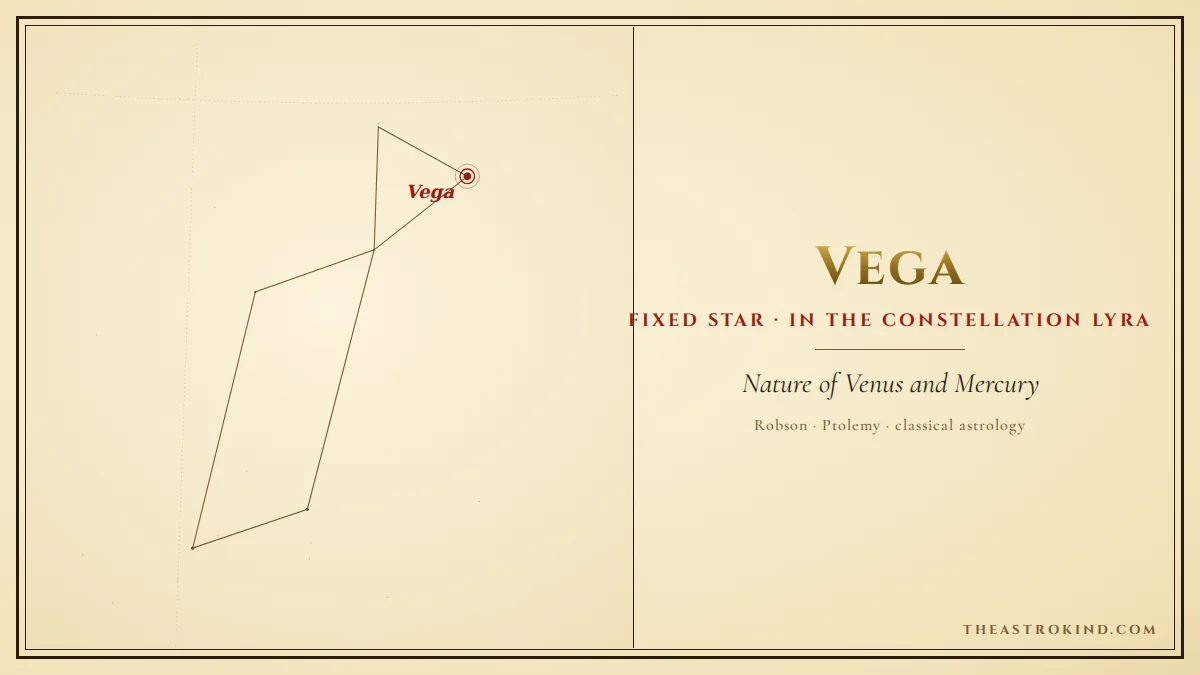
In my 30 years of practice, few fixed stars provoke as much fascination as Vega. Known to the ancients as the Falling Vulture and the brightest gem of the celestial Harp (Lyra), Vega carries a dual promise: soaring artistic genius and a precipitous fall. For those with Vega prominent in their natal chart, the question is not whether they will rise, but how they will manage the descent.
Vega in the Classical Tradition
Ptolemy, in the Tetrabiblos, classified Vega as of the nature of Venus and Mercury. This combination grants a refined aesthetic sense, a love of harmony, and a quick, inventive mind. Guido Bonatti, echoing earlier sources, described it as conferring “a dignified, courteous, and cheerful disposition, with a gift for music and poetry.” Yet the star’s very name in Arabic, al-Wāqi‘, means “the falling” — a reference to the constellation Lyra’s myth of Orpheus, who descended into the underworld and lost his beloved Eurydice.
Vivian Robson, in Fixed Stars and Constellations in Astrology, warns that Vega “gives a dual nature, artistic ability, and a tendency to sudden changes of fortune.” The star is associated with the vulture — a bird that soars high but feeds on carrion. This is the core paradox: Vega can lift you to the heights of creative expression, but it also carries the risk of a fall from grace, often through pride, scandal, or a fatal flaw.
Vega in the Natal Chart: Where to Look
To assess Vega’s influence, you must first locate it in your chart. Its ecliptic longitude is approximately 15° Capricorn (precessed to 2025). Any planet or angle within 1° of this point is strongly affected. Conjunctions with the Ascendant, Midheaven, Sun, Moon, or the benefics (Venus, Jupiter) are most potent. Even a square or opposition can manifest the star’s tension between aspiration and downfall.
When Vega conjoins the Midheaven, it often indicates a public career in the arts, entertainment, or any field requiring performance. I have observed clients with this placement who are gifted musicians, actors, or speakers. Yet the same placement can bring notoriety — a fall from public favor that is as dramatic as the rise. The key is the native’s moral compass and humility.
The Celestial Harp: Creative Genius and Its Price
Vega’s association with the lyre of Orpheus underscores its link to music and poetry. Orpheus could charm all of nature with his music, but he could not resist looking back at Eurydice, losing her forever. This myth encapsulates Vega’s lesson: the artist must sometimes let go of what they love most to preserve their art. In a natal chart, Vega often indicates a person who will sacrifice personal happiness for creative expression.
Jean-Baptiste Morin, in Astrologia Gallica, noted that fixed stars of the nature of Venus and Mercury “exalt the imagination but also incline to sensuality and indiscretion.” Vega’s placement by sign and house will show where this tension plays out. For example, Vega in the 5th house (creativity, romance) can produce a brilliant artist whose love affairs are tragic. In the 7th house, it may attract a partner who is both inspiring and destructive.
Practical Takeaway
- Locate Vega: Check if any natal planet or angle is within 1° of 15° Capricorn. Use a precise ephemeris or a fixed stars calculator → to get the exact precessed position for your birth year.
- Assess the nature: Venus-Mercury influence suggests artistic talent, but also a need for discipline. The “falling” aspect warns against hubris and reckless decisions.
- Watch the transits: When transiting planets cross 15° Capricorn (or oppose it at 15° Cancer), they activate Vega. Pay attention to sudden opportunities or crises in creative or public matters.