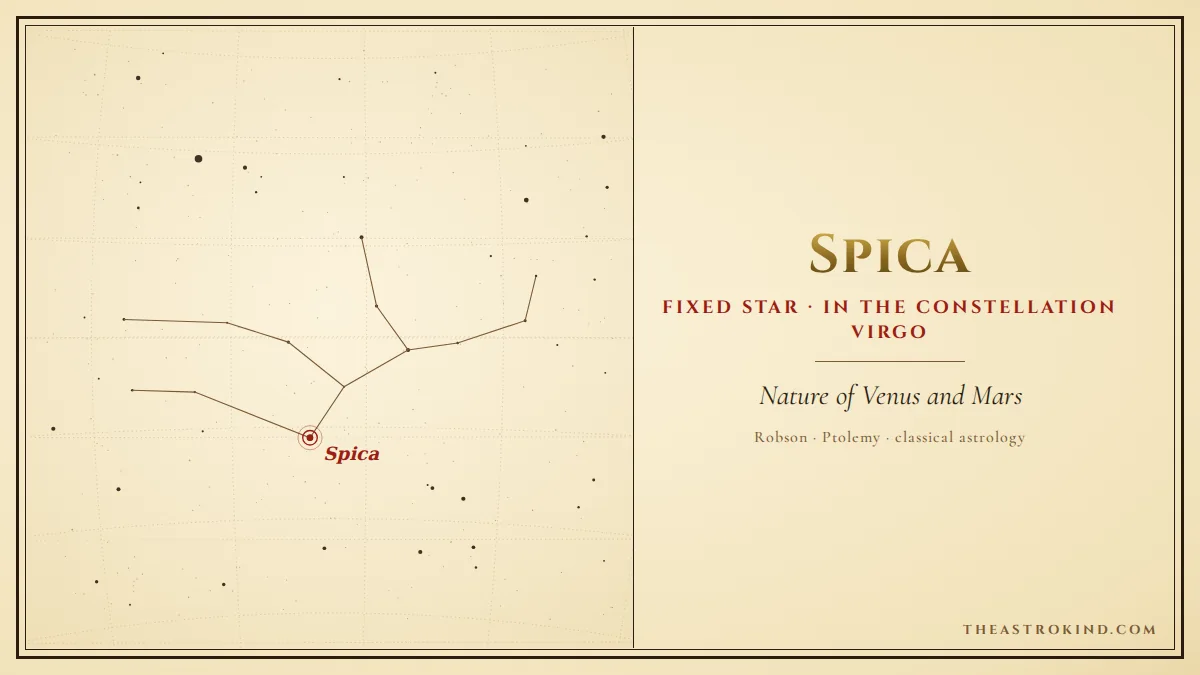
In my 30 years of practice, few fixed stars command as much reverence as Spica. Known as the "Gift Star" or "Protector of Virgo," Spica is one of the most benefic points in the heavens. When it appears prominently in a natal chart, it often signals a life touched by fortune, talent, and a certain invulnerability to misfortune. Let us examine this star through the lens of classical astrology, drawing on the authorities who have shaped our understanding.
The Nature and Mythology of Spica
Spica (Alpha Virginis) is the brightest star in the constellation Virgo, located near the ecliptic at approximately 23°50' Libra (sidereal) or 24° Virgo (tropical, precessed to 2025). Ptolemy in the Tetrabiblos described it as having a Venus-Mars nature, but later tradition—especially through Vivian Robson's Fixed Stars and Constellations in Astrology—emphasizes its Jupiter-Venus character: honor, wealth, and artistic genius. The star's name derives from the Latin spicum, meaning "ear of grain," which Virgo holds in her hand. This imagery ties Spica to harvest, abundance, and the fruits of labor.
Mythologically, Spica is associated with Demeter (Ceres), the goddess of agriculture, and with Astraea, the goddess of justice who fled the earth during the Iron Age. Thus, Spica carries themes of righteousness, reward for effort, and a return to a golden age of harmony. In mundane astrology, its heliacal rising was considered a portent of prosperity for the coming year.
Spica in the Natal Chart: General Significance
When Spica is conjunct an angle (Ascendant, Midheaven, Descendant, or IC), or in close conjunction with a personal planet (Sun, Moon, Mercury, Venus, Mars), its influence is magnified. Guido Bonatti, in his Liber Astronomiae, listed Spica among the Behenian stars—those of special power—and prescribed its use in talismans for wealth and protection. In a natal chart, Spica often bestows:
- Natural talent: Especially in the arts, sciences, or any field requiring precision and dedication. Many renowned musicians and inventors have Spica prominent.
- Good fortune: A tendency to escape harm, recover from setbacks, or receive unexpected help. William Lilly noted that Spica "gives honor, riches, and a happy end."
- Moral integrity: The star's association with justice inclines the native toward honesty and fairness, though it can also make one overly critical (the Virgo shadow).
However, Spica is not a free pass. Its benefits are earned through effort and discipline. As Jean-Baptiste Morin wrote in Astrologia Gallica, fixed stars act through the planets they conjoin; Spica amplifies the nature of that planet but demands that the native align with its higher vibration.
Spica Conjunct the Sun or Moon
With the Sun, Spica indicates a person of radiant talent and leadership, often in creative or humanitarian fields. The native may be a natural healer or teacher. With the Moon, it suggests emotional resilience, a nurturing instinct, and a strong connection to nature. The Moon-Spica native often has a calming presence and may be drawn to gardening or cooking as therapy.
Spica Conjunct Mercury, Venus, or Mars
Mercury with Spica sharpens the intellect and gives a gift for communication—writing, speaking, or teaching. Venus with Spica enhances artistic ability and brings harmonious relationships, though it can also indicate a love of luxury. Mars with Spica channels energy into constructive achievement; the native is a tireless worker who achieves mastery through persistence.
Spica in the Houses and Signs
The house placement of Spica shows the area of life where its blessings manifest. In the 1st house, it gives a charismatic, fortunate personality. In the 10th, it promises fame and success in one's career. In the 2nd, it brings wealth through talent. In the 6th, it protects health and aids in service to others. In the 7th, it blesses partnerships. In the 12th, it grants spiritual protection and may indicate hidden talents or a secret benefactor.
Sign-wise, Spica is most potent in Virgo (its home sign) and Libra (where it is exalted in some systems). In Virgo, it perfects the sign's analytical and service-oriented gifts. In Libra, it brings balance and artistic refinement. In other signs, it modifies the expression: in Sagittarius, it may inspire philosophical or religious work; in Pisces, it can manifest as musical or poetic genius.
Practical Takeaway
- Locate Spica in your natal chart using a fixed stars calculator (precessed to your birth year). Pay attention to conjunctions within 1° with planets or angles.
- If Spica is prominent, cultivate the area of life indicated by its house and sign. Your natural talents will flourish with disciplined effort.
- Use Spica's protective energy in talismanic magic or meditation, especially during its heliacal rising (around September 16-18 in the Northern Hemisphere).
- Remember: Spica rewards integrity. Stay honest and diligent, and fortune will follow.