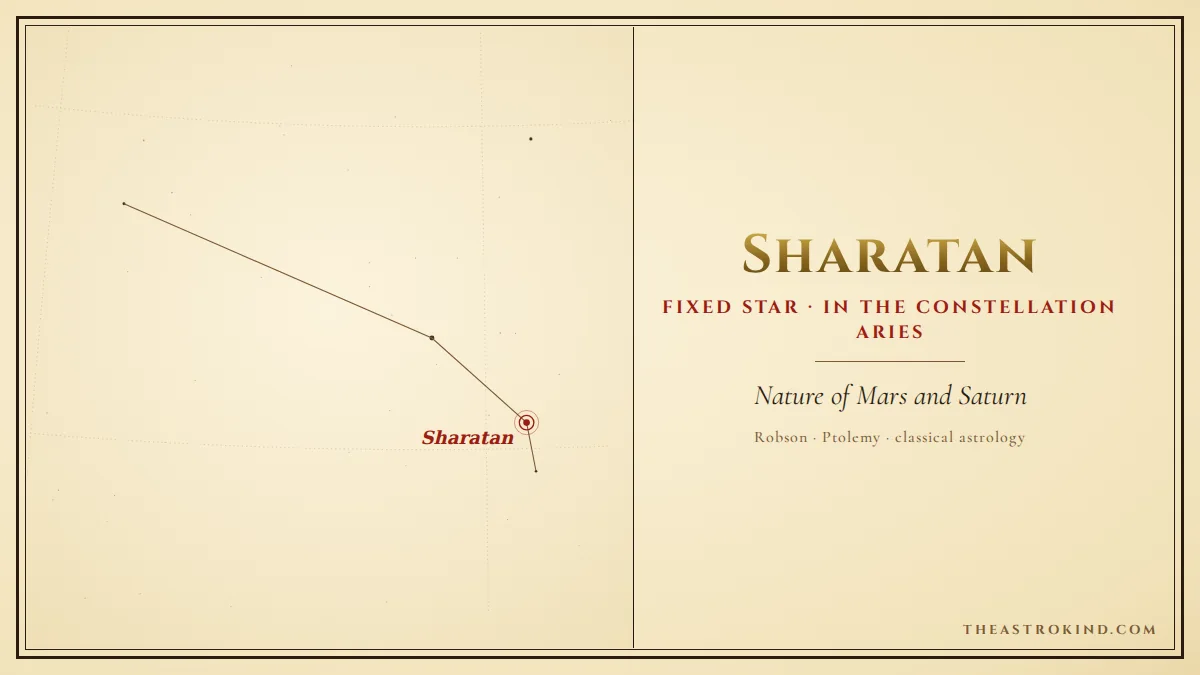
Sharatan (β Arietis), also known as Sheratan, is a binary star system in the constellation Aries. It is the second brightest star in the Ram, with a visual magnitude of 2.6, and it lies in the horn of the Ram, near Mesarthim. In classical astrology, Sharatan is of the nature of Mars and Saturn, a combination that speaks of force, resistance, and often of hardship. Its name derives from the Arabic al-sharaṭān, “the two signs” or “the two marks,” referring to the pair formed with Mesarthim.
What does Sharatan signify in the natal chart?
When we find Sharatan in the natal chart, we are dealing with a star that does not promise ease. Robson, in his Fixed Stars and Constellations in Astrology, is blunt: “Bodily injuries, unscrupulous defeaters, destruction by fire, war or earthquake.” This is the traditional reading, and it should not be softened. However, as with all fixed stars, the full picture emerges only when we consider the planet it aspects, the angle it occupies, and the overall condition of the chart.
Sharatan is not a star of passive misfortune; it is a star of active conflict. It describes situations where the native faces opposition, often from hidden or unscrupulous enemies, and where physical risk or violent circumstances may arise. The Mars-Saturn nature combines audacity with cold calculation, and it can manifest as ruthless ambition or as the experience of being on the receiving end of such ambition.
In my three decades of practice, I have observed that Sharatan is rarely prominent in charts of people who lead quiet, sheltered lives. It tends to appear in the charts of those who are exposed to struggle, whether by profession, circumstance, or temperament. This does not mean the native is doomed; it means the life carries a particular kind of tension that must be managed with awareness.
Sharatan on the angles
When Sharatan is conjunct an angle—especially the Ascendant or Midheaven—its influence is magnified and becomes a defining feature of the personality or public life. On the Ascendant, it may indicate a person who is physically vulnerable to injury or who faces hostility from others. There can be a marked intensity in the gaze or demeanor, a certain hardness born of experience. The native may be drawn to dangerous occupations or environments.
On the Midheaven, Sharatan can bring notoriety, but often of a contentious kind. The career may involve conflict, litigation, or even military or emergency services. Robson’s “unscrupulous defeaters” may appear as rivals in the professional sphere. The native must be cautious of enemies who operate behind the scenes. Yet, if well supported by benefic aspects, this position can also grant the resilience needed to overcome such opposition.
On the Descendant or Imum Coeli, the star may point to difficulties originating from partners or family. The home itself could be a place of strife or physical danger. It is essential to examine the ruler of the angle and its condition to judge how the star’s influence will be channeled.
Sharatan conjunct planets
The planet conjunct Sharatan reveals the area of life where its Mars-Saturn energy is most acutely expressed. With Mars, the risk of accidents, violence, or surgery is heightened. The native may be prone to impulsive actions that lead to bodily harm. With Saturn, the theme of defeat or limitation by others is emphasized, and there may be a chronic fear of failure or persecution. The native must learn to build structures that withstand external pressure.
With the Sun, the native’s vitality and sense of self may be tested by conflicts. The father or authority figures could be a source of hardship. With the Moon, emotional security is challenged, and the native may experience sudden upheavals or losses. With Mercury, the mind is sharp but prone to harsh speech, and there may be disputes, slander, or legal battles.
With Venus, relationships are complicated by jealousy or rivalry, and there may be a tendency to attract partners who are combative. With Jupiter, the expansive qualities are tempered by Saturn’s restraint, and the native may struggle to find faith or optimism. It is crucial to note that the house placement of the planet will further specify the area of life affected.
How to interpret Sharatan in practice
First, determine the exact position of Sharatan in the natal chart. It is located at approximately 3°58′ of Taurus in the tropical zodiac (for the year 2000), but due to precession, it moves about 50.3 seconds of arc per year. Use a reliable ephemeris or fixed star calculator to find its current position. Then, check for conjunctions with planets (within 1-2° orb) and angles (within 1°).
Second, assess the condition of the planet in conjunction. A dignified planet can better handle the star’s harshness, while a debilitated one may succumb to its worst expressions. Consider the aspects the planet receives: benefic aspects can mitigate, while malefic aspects can exacerbate.
Third, look at the house placement. The house will show the arena of life where the star’s influence is most likely to manifest. For example, in the 6th house, it may indicate health issues or conflicts with coworkers; in the 7th, open enemies or a difficult marriage; in the 10th, a contentious career.
Finally, remember that fixed stars are not deterministic. They describe potentials and tendencies, and the native’s awareness and choices can alter the outcome. As Lilly wrote, “the stars incline, but do not compel.” Sharatan demands caution and resilience, but it can also forge strength of character.
In practice
- Identify Sharatan’s position by sign and degree, and check for conjunctions with planets and angles within a 1-2° orb.
- Evaluate the condition of the conjunct planet: dignity, aspects, and house placement will modify the star’s expression.
- Be mindful of potential physical risks and conflicts, especially if Sharatan is on the Ascendant or conjunct Mars or Saturn.
- Use the star’s energy constructively by cultivating discipline, strategic thinking, and resilience in the face of opposition.