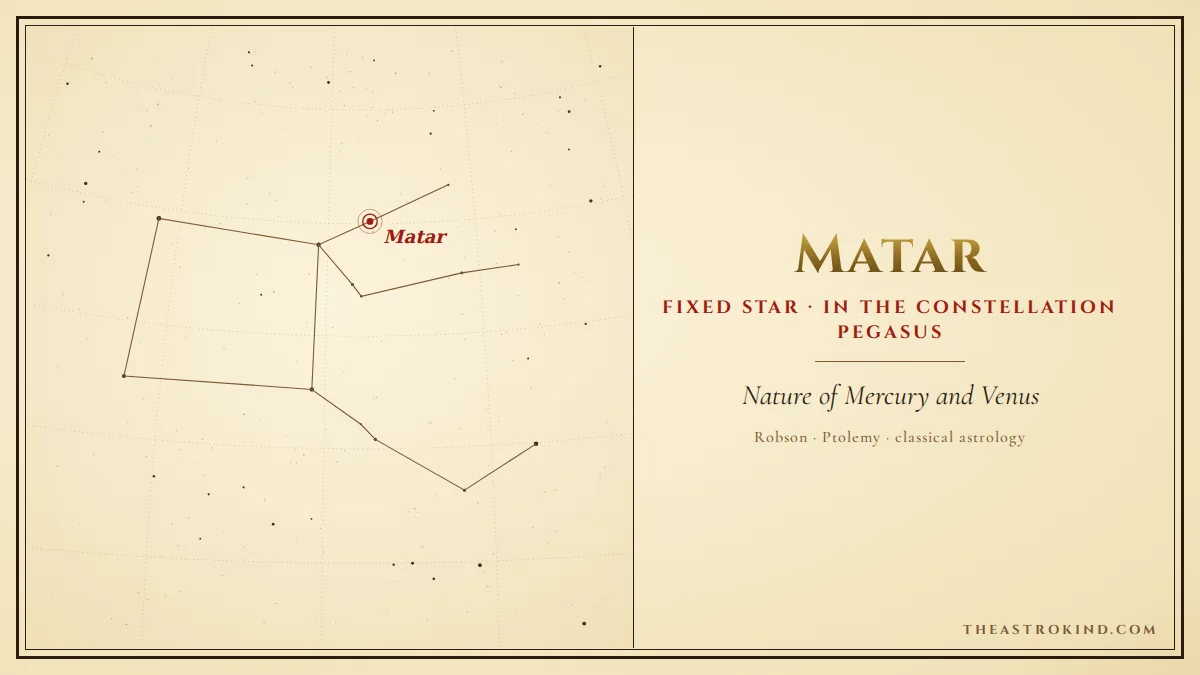
Matar is a fixed star of the second magnitude in the constellation Pegasus, situated in the shoulder of the winged horse. In the natal chart, its position by fixed stars calculator reveals where its influence falls. According to Vivian Robson in Fixed Stars and Constellations in Astrology, Matar is of the nature of Mercury and Venus, and he writes: “Good fortune from the heavens, success through intellectual ability. Connected with rain and abundance.” In this article I explain what Matar signifies in the natal chart, especially when it is on an angle or conjunct a planet, following the classical doctrine of Robson and the traditional authors.
What is Matar and what does it signify?
Matar is the star Eta Pegasi, located at about 24° of Aquarius in the tropical zodiac (the exact position varies with the epoch; use our calculator for the current value). It is one of the stars in the shoulder of Pegasus, the winged horse of Greek myth. In classical astrology, fixed stars are not mere decorations; they add a specific tone to the planet they aspect or the house they occupy. Robson assigns Matar the nature of Mercury and Venus: Mercury governs the intellect, speech, writing, and commerce; Venus governs harmony, pleasure, and abundance. Thus Matar combines intellectual acuity with a benefic and pleasant quality.
Robson's brief description is dense with meaning: “Good fortune from the heavens” suggests that benefits come from above, often unexpectedly or through circumstances beyond one's control. “Success through intellectual ability” indicates that the native's mental faculties—reason, learning, communication—are the primary vehicle for advancement. “Connected with rain and abundance” links Matar to fertility and material prosperity, especially in matters ruled by the house it occupies. In horary and natal charts, this star can indicate a natural gift for learning, teaching, writing, or any Mercury-Venus pursuit such as art, diplomacy, or trade.
The nature of Matar: Mercury and Venus
In the tradition of Ptolemy and Lilly, the nature of a fixed star is determined by the planets whose qualities it shares. Matar's Mercurial side gives quickness of mind, adaptability, and skill in argument; its Venusian side adds charm, sociability, and a love of beauty. When Matar is prominent, the native may excel in fields that require both intellect and grace: literature, law, negotiation, or the arts. However, as with all fixed stars, the condition of the planet it aspects is crucial. A well-aspected Mercury or Venus will bring out Matar's best; a afflicted one may scatter its gifts.
Matar on the angles
The angles—the Ascendant, Midheaven, Descendant, and Imum Coeli—are the most sensitive points of the natal chart. A fixed star conjunct an angle (within 1–2 degrees) is considered highly active. When Matar is on the Ascendant, it shapes the native's physical appearance and temperament: often a pleasant countenance, a lively mind, and a sociable disposition. The Ascendant signifies the native's body and vital spirit, so Matar here may indicate good health and a fortunate start in life, though Robson warns that all fixed stars can bring reversals if the natal chart is afflicted.
On the Midheaven, Matar's influence falls on career, reputation, and public standing. This position suggests success through intellectual pursuits—writing, teaching, commerce, or diplomacy—and the favor of superiors. The native may gain recognition for their mental abilities and enjoy a good name. On the Descendant, Matar affects partnerships and open enemies; it may bring beneficial alliances, especially with learned or artistic people. On the Imum Coeli, it touches the home, family, and the end of matters; here it can indicate domestic happiness and inheritance, or abundance in real estate.
Matar conjunct planets
When Matar is conjunct a planet, it modifies that planet's expression according to its Mercury-Venus nature. Conjunct Mercury, it sharpens the intellect and gives a gift for languages, writing, or oratory; Robson's “success through intellectual ability” is most literal here. Conjunct Venus, it enhances charm, artistic taste, and the capacity for pleasant relationships; it may also indicate financial gain through art or luxury goods. Conjunct the Moon, it can bring popularity and a fertile imagination, but also a tendency to emotional fluctuation if the Moon is afflicted.
Conjunct the Sun, Matar may confer honors and recognition, especially in intellectual or diplomatic fields. Conjunct Jupiter, it amplifies good fortune and generosity, often with a philosophical or religious bent. Conjunct Saturn, the benefits may come later in life or through disciplined mental work. With Mars, there is energy and drive, but also potential for disputes if the star's benefic side is not well integrated. In all cases, the classical rule holds: the star's effect is filtered through the planet's condition and dignity.
How to judge Matar in the natal chart
To judge Matar correctly, follow the method of the classical authors. First, locate Matar's exact position for the birth date using a reliable ephemeris or our fixed stars calculator. Then, check for conjunctions with planets, angles, or lots within 1–2 degrees (or up to 5 degrees for the Sun and Moon). Consider the planet's dignity, house, and aspects. A planet conjunct Matar in its own sign and well-aspected will manifest the star's benefits strongly; a peregrine or afflicted planet will dilute them. Also note the house Matar occupies, as it shows the area of life where its influence is most felt.
Robson's brief description is a starting point, not a full delineation. In my own practice, I have observed that Matar often marks individuals who earn their livelihood through their wits—writers, teachers, merchants—and who seem to enjoy a certain natural luck in their endeavors. However, as with all fixed stars, it does not override the fundamental testimony of the natal chart. Use it as a confirming factor, not as the sole basis for judgment.
In practice
- Calculate Matar's exact position for the birth date and compare it with planets and angles within 1–2 degrees.
- Assess the condition of the planet conjunct Matar: dignity, house, and aspects determine whether its benefits manifest.
- Look at the house Matar occupies to see the area of life where its influence is strongest.
- Combine Matar's testimony with the overall natal chart; never judge a star in isolation.