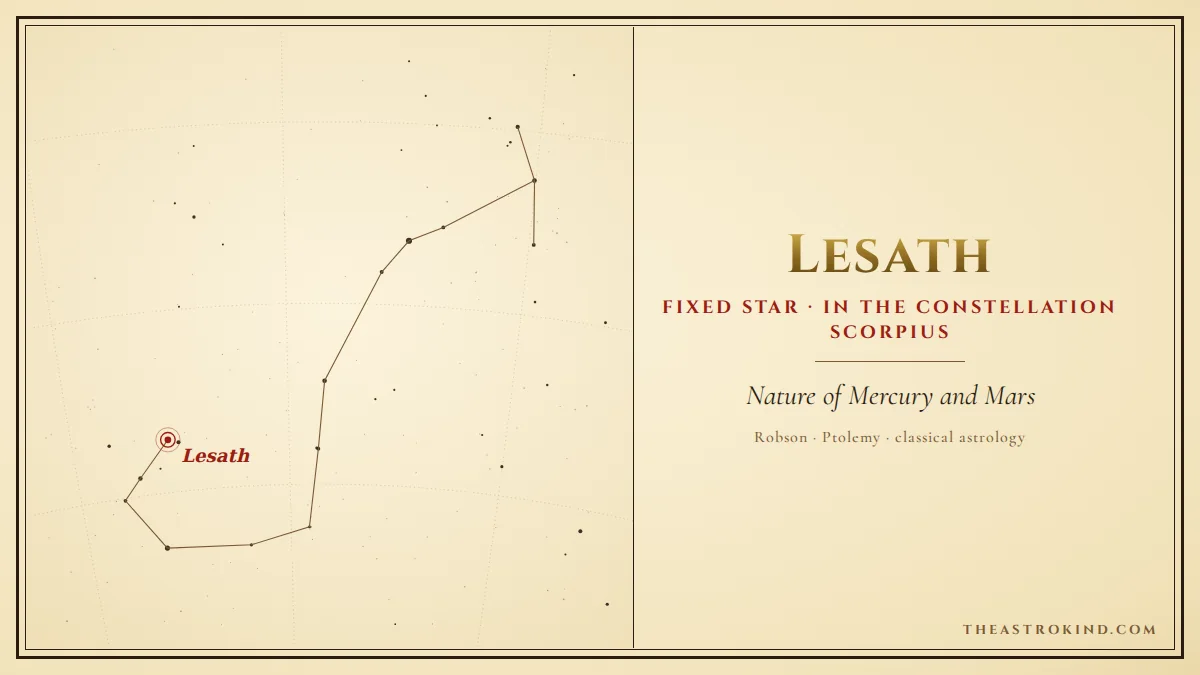
In my 30 years of practice, I have seen many astrologers tremble at the mention of Algol or Antares, yet few pay due attention to the second sting of the Scorpion: Lesath. This star, often overlooked, carries a venomous intensity that can manifest as sharp intellect, piercing insight, or destructive tendencies—depending on how it is configured in the natal chart. In this article, we will dissect Lesath's astrological significance, drawing from classical sources and modern observation, to answer the question: how do you interpret this fixed star when it appears in a birth chart?
The Nature of Lesath: A Star of Venom and Sharpness
Lesath, also known as Upsylon Scorpii, lies at the tip of the Scorpion's tail, close to Shaula (Lambda Scorpii). Its name derives from the Arabic al-Las'ah, meaning "the sting" or "the bite." Ptolemy, in the Tetrabiblos, classified the bright stars in the tail of Scorpio as of the nature of Mars and partly of Saturn. This combination is telling: Mars brings aggression, passion, and a cutting edge; Saturn adds severity, endurance, and a tendency toward melancholy or restriction.
Vivian Robson, in his seminal work Fixed Stars and Constellations in Astrology, describes Lesath as causing "venomousness, malevolence, and danger of poisoning." He also notes that it gives "shrewdness, keen perception, and a sharp tongue." This duality is crucial: Lesath is not merely malefic; it bestows a mental acuity that can cut through deception—but at a price. The native may be prone to sarcasm, bitterness, or a tendency to use words as weapons.
In classical astrology, fixed stars act through the planets they conjoin or aspect. Lesath's influence is most potent when it is in conjunction with a personal planet, especially the Moon, Mercury, or Mars, or with the Ascendant or Midheaven. Its position in the zodiac is approximately 24° Sagittarius, and its declination is about -37°, making it a southern star. This southerly placement often indicates that its effects are more internalized or expressed in hidden, subtle ways.
Lesath in the Natal Chart: Key Configurations
When interpreting Lesath in a natal chart, the astrologer must consider the house, sign, and aspects. A conjunction with the Ascendant, for example, can give a piercing gaze and a personality that others find intimidating or magnetic. The native may have a sharp wit and a tendency to speak bluntly, sometimes without regard for social niceties. This can lead to conflict, but also to a reputation for honesty and directness.
If Lesath conjoins the Midheaven, the native may achieve prominence through a career that involves cutting-edge analysis, surgery, law, or investigative work. The venomous quality can be channeled into exposing corruption or fighting injustice. However, there is also a risk of scandal or professional rivalry, as enemies may be made easily.
Conjunctions with the Moon or Mercury are particularly telling. The Moon with Lesath can produce emotional intensity, a tendency to brood, and a sharp memory for slights. This placement may indicate a person who is easily wounded and who retaliates with verbal barbs. Mercury with Lesath, on the other hand, gives a brilliant mind, capable of deep research and penetrating insight. The native may excel in fields like forensic science, psychology, or satire. Yet, there is a danger of becoming cynical or using knowledge to manipulate others.
Mars with Lesath amplifies the martial nature, potentially leading to a hot temper, a propensity for accidents, or a fascination with weapons. This combination requires careful management, as impulsive actions can have venomous consequences. Saturn with Lesath may produce a stoic, enduring individual who can withstand great hardship but may also be prone to chronic bitterness or a desire for revenge.
Aspects to Lesath: The Role of Malefics and Benefics
In traditional astrology, aspects from benefics (Jupiter and Venus) can mitigate the harshness of Lesath, while malefics (Mars and Saturn) can exacerbate it. A trine from Jupiter, for instance, might soften the sting, allowing the native to use their sharpness for philosophical insight or teaching. A square from Mars, however, could lead to violent outbursts or legal troubles.
It is also important to consider the condition of the planet that is conjoined with Lesath. If that planet is dignified (in its domicile or exaltation), the native may have more control over the star's energy. If the planet is in detriment or fall, the negative traits may dominate. For example, a Moon in Capricorn (exalted) with Lesath might express the venom as disciplined ambition, while a Moon in Scorpio (fall) could become obsessive and vindictive.
I have observed in my consultations that Lesath often manifests as a "double-edged sword." Natives with this star prominent in their charts frequently report a life marked by moments of intense focus and achievement, followed by periods of isolation or conflict. The key is to recognize the venom as a tool—one that can be used for healing or for harm.
Historical and Mythological Context
To fully appreciate Lesath, we must look to its mythological roots. The constellation Scorpio is associated with the scorpion that killed Orion, the hunter. In Greek myth, Scorpio was sent by Gaia (or Artemis) to punish Orion's arrogance. The sting of the scorpion is thus a symbol of divine retribution—a reminder that pride precedes a fall. Lesath, as the second sting, reinforces this theme of punishment for hubris.
In the Almagest, Ptolemy lists the stars in the tail of Scorpio as having an effect similar to Mars and Saturn. Guido Bonatti, in his Liber Astronomiae, echoes this, warning that such stars bring "destruction, poison, and treachery." However, he also notes that they can give "victory over enemies" if properly harnessed. This martial aspect is key: Lesath is not a passive malefic; it is an active agent of change, often through conflict.
Robson also connects Lesath to the concept of "the sting of conscience." Natives with this star may be their own harshest critics, or they may be plagued by guilt over past actions. This psychological dimension is often overlooked in modern astrology, but it is essential for a complete interpretation.
Practical Takeaway
- Identify the prominence: Check if Lesath is conjunct your Ascendant, Midheaven, Sun, Moon, or personal planets (Mercury, Venus, Mars). A conjunction within 1-2 degrees is most significant.
- Assess the planetary condition: Determine if the planet involved is dignified or debilitated. This will tell you whether the venom is more likely to be expressed constructively or destructively.
- Channel the sharpness: Use the piercing intellect and directness of Lesath in careers or hobbies that require precision, such as surgery, editing, research, or advocacy. Avoid using words as weapons in personal relationships.
- Watch for triggers: Be mindful of situations that provoke jealousy, resentment, or a desire for revenge. These are the moments when Lesath's sting can turn inward or outward.
→ Explore our fixed stars calculator to see if Lesath is prominent in your chart →