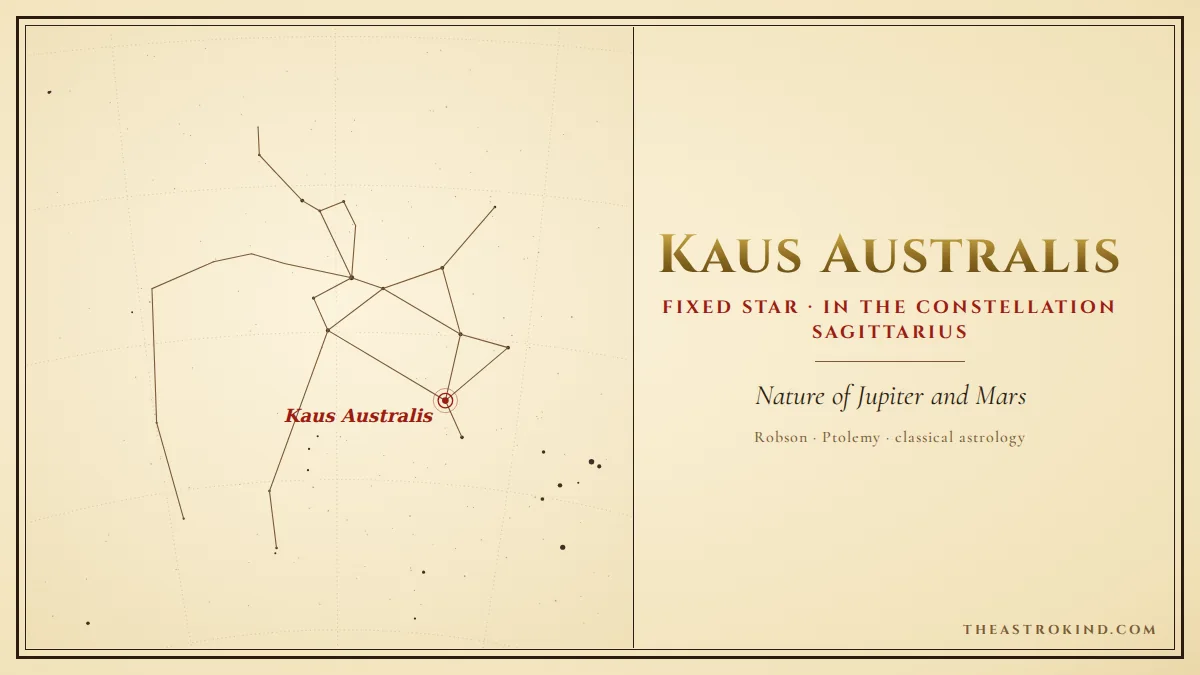
Kaus Australis is the brightest star of Sagittarius and one of the most misunderstood fixed stars in natal work. It is the southern star of the Archer’s bow, a first-magnitude luminary of the southern sky, and it carries a nature that is genuinely double: Jupiter and Mars. That combination is not a contradiction; it is a directive. Where Kaus Australis falls in the natal chart, the native is asked to aim, to lead, and to keep the aim clean.
What Kaus Australis Is, and What It Is Not
Kaus Australis, also catalogued as Epsilon Sagittarii, sits at roughly 5° Sagittarius in the tropical zodiac, depending on the ayanamsa and the precession correction you use. It is a star of magnitude 1.8, bright enough to be visible to the naked eye and prominent enough to matter in any serious delineation. Its latitude places it close to the ecliptic, which is why it can form tight conjunctions with planets and angles.
Vivian Robson, in his Fixed Stars and Constellations in Astrology, assigns it the nature of Jupiter and Mars and gives the keywords: promotions, idealistic nature, influential leadership, mental alertness and keen perception. That is a precise list. It is not a soft star. It does not promise comfort. It promises advancement through directed effort, and it rewards those who can hold an ideal without becoming a fanatic about it.
In my own practice, I have found that Kaus Australis rarely acts alone. It works through the planet it touches, and it works through the house it occupies. A star is a condition, not a planet. It colours, it does not command.
The Jupiter–Mars Signature
Jupiter gives expansion, meaning, law, and the long view. Mars gives initiative, courage, and the capacity to cut through obstruction. When these two are fused in a fixed star, the result is a native who wants to build something that matters and is willing to fight for it. The danger is equally clear: self-righteousness, ideological aggression, and the belief that one’s own aim is the only legitimate one.
This is why Kaus Australis is often found in the charts of teachers, officers, reformers, and athletes — people whose work requires both a doctrine and a drive. Bonatti, in the Liber Astronomiae, treats stars of this mixed temperament as indicators of dignitas earned through action rather than inherited. That is the correct frame.
Kaus Australis on the Angles
When Kaus Australis is conjunct an angle, it becomes visible in the life. The angles are the doors of the chart, and a star on a door is a star that people see.
On the Ascendant, it gives a direct, purposeful presence. The native is perceived as someone with a mission, even before they have articulated one. Robson’s “influential leadership” is most literal here. On the Midheaven, it points to a career marked by promotion and public standing, often in law, education, military service, religion, or any field where a stated ideal is the product. On the Descendant, it shows up in partnerships: the native attracts strong-willed, idealistic people, and must learn not to confuse shared conviction with compatibility. On the IC, it roots the family line in a tradition of principle, sometimes rigidly so.
In every case, the star demands that the native’s public aim match their private conduct. When it does not, the fall is as public as the rise.
Kaus Australis Conjunct a Planet
A conjunction within 2° is the working orb for a star of this magnitude; within 1° it is unmistakable. The planet is the agent, and Kaus Australis supplies the tone.
Conjunct the Sun: the identity is organised around a cause. Leadership is natural, but so is the temptation to equate personal will with universal law. Conjunct the Moon: the emotional life is idealistic and restless; the native needs a mission to feel safe. Conjunct Mercury: mental alertness and keen perception are heightened — excellent for debate, teaching, and strategy, but prone to dogmatism.
Conjunct Venus: values are elevated, and relationships are chosen on principle rather than convenience. Conjunct Mars: the purest expression of the star’s martial side — courage, initiative, and a fighting spirit that needs a worthy target. Conjunct Jupiter: the classical signature of promotion and influence, but also of overreach. Conjunct Saturn: the ideal is disciplined and durable; advancement comes slowly and is therefore secure.
With the outer planets, the effect is generational rather than personal, unless the planet is angular or tightly aspecting the luminaries. In those cases, Kaus Australis adds a note of purposeful conviction to whatever the outer planet signifies.
Judgment in Practice
Do not read Kaus Australis as a promise of fame. Read it as a promise of direction. The star rewards those who aim well and punishes those who aim carelessly. Ptolemy, in the Tetrabiblos, reminds us that stars of mixed nature produce mixed outcomes, and the outcome depends on the condition of the planet they contact. A dignified Jupiter with Kaus Australis builds institutions. A debilitated Mars with the same star burns bridges.
Look always at the ruler of the sign the star occupies, the condition of the conjunct planet, and the house the conjunction falls in. That is the whole technique. There is no shortcut, and no need for one.
Practical takeaway
- Use a 2° orb for conjunctions; 1° for unmistakable effect.
- On the angles, expect visible leadership and public promotion — with equal public accountability.
- With the Sun, Moon, Mercury, Mars, or Jupiter, expect idealistic drive and keen perception; guard against dogmatism.
- Always judge the conjunct planet’s dignity and the house it rules before pronouncing on the star.