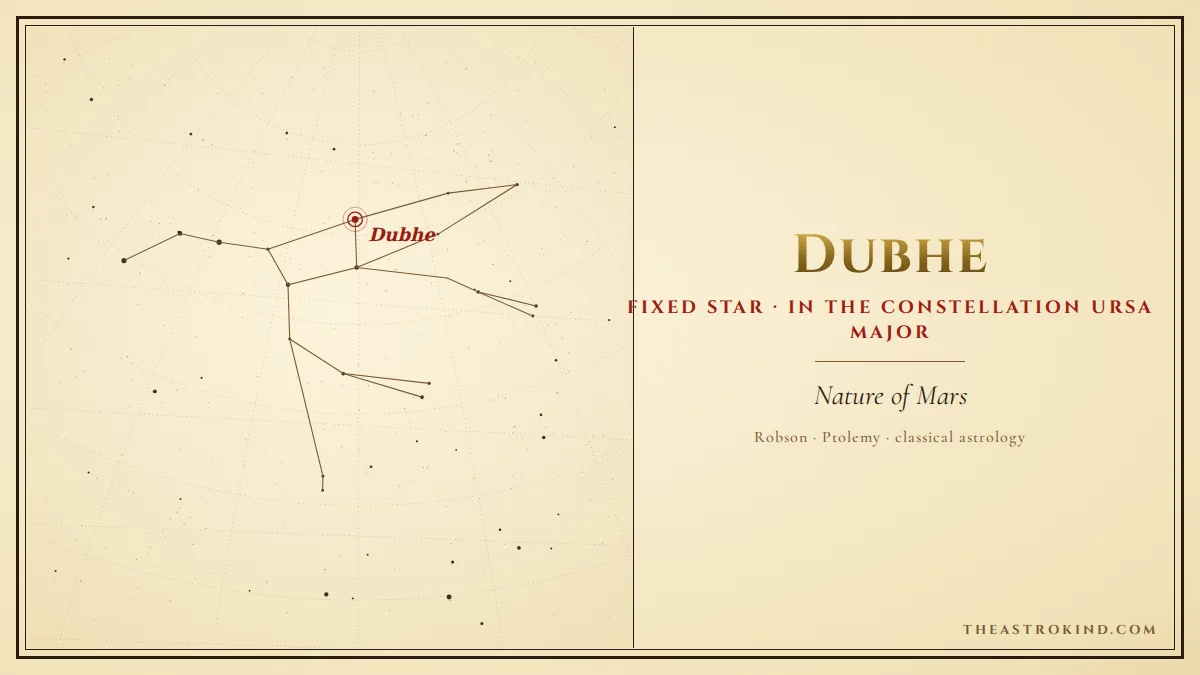
Dubhe, Alpha Ursae Majoris, is the brightest star of the Great Bear and one of the most misunderstood points in natal astrology. At magnitude 1.8, it is a first-magnitude star, and its position at the Bear's shoulder gives it a martial, unyielding character. In my thirty years of practice, I have seen Dubhe act as a catalyst: it does not create character, it reveals it under pressure. This article explains what Dubhe in the natal chart means, especially when it is angular or conjunct a planet, and how to judge it without falling into fatalism.
What Is Dubhe? Nature and Tradition
Dubhe lies at approximately 15° of Leo in the tropical zodiac, though precession moves it slowly. It is a yellow giant, the second closest of the Big Dipper's stars, and its name comes from the Arabic dubb, meaning bear. Classical authors classified it as of the nature of Mars, and Vivian Robson, in his Fixed Stars and Constellations in Astrology, described it as: "Destructive and psychic power, arrogance, astrology, violence, and boldness." That is a dense, contradictory list, and it demands careful reading.
The Mars nature means heat, drive, courage, and conflict. The "psychic power" is not New Age intuition; it is the capacity to perceive hidden motives and to act on that perception. Arrogance arises when the native mistakes force for wisdom. Astrology itself appears in the list because Dubhe grants an aptitude for reading cycles and symbols, but often with a combative edge. Violence and boldness are the two poles of the same impulse: the will to break resistance, whether in a just cause or a reckless one.
Dubhe on the Angles
When Dubhe is conjunct the Ascendant, the native presents as forceful, direct, and hard to ignore. The body is often robust, and the eyes carry a fixed, evaluating quality. These individuals are natural leaders in a crisis, but they can alienate allies through sheer intensity. The Mars nature makes them quick to defend, slow to apologize.
On the Midheaven, Dubhe points to a career marked by struggle and visibility. Professions involving command, surgery, engineering, military or police work, and astrology itself are common. The native rises through conflict, not through charm. On the Descendant, the same force is projected onto partners: relationships become power struggles unless the native learns to yield strategically. On the Imum Coeli, Dubhe indicates a turbulent family root, often a lineage of strong-willed figures, and a private life that feels like a fortress under siege.
Dubhe Conjunct Planets in the Natal Chart
The conjunction is the only aspect that truly matters with fixed stars. A planet within one or two degrees of Dubhe will express its own nature through a martial, uncompromising filter. The orb should be tight; beyond two degrees, the effect fades into background noise.
Sun, Moon, and Mars
Sun conjunct Dubhe gives a proud, self-reliant core. The native identifies with strength and may confuse vulnerability with weakness. Authority comes naturally, but so does opposition. Moon conjunct Dubhe produces an emotionally fierce temperament: protective, reactive, and deeply loyal, yet prone to sudden rages when security is threatened. The psychic side shows as vivid dreams and strong instincts about people.
Mars conjunct Dubhe is the purest expression of the star. Here we find physical courage, competitive drive, and a tendency toward accidents or surgery. These natives must channel aggression into disciplined work, or it turns inward as inflammation and stress. Robson's "violence" is not destiny; it is raw voltage that requires a grounded circuit.
Mercury, Venus, and Saturn
Mercury conjunct Dubhe sharpens the mind into a weapon. Speech is blunt, argumentative, and often brilliant. These are the debaters, the critics, the astrologers who cut through nonsense. Venus conjunct Dubhe complicates love: desire is intense, jealousy possible, and partnerships require equality of strength. Saturn conjunct Dubhe is a hard placement, indicating a life of heavy responsibility, often with a stern father figure or early loss. It builds endurance, but at a cost.
How to Judge Dubhe Without Fatalism
Classical authors such as Bonatti and Lilly warned against reading a single star in isolation. Dubhe must be judged by the condition of its dispositor, the planet it touches, and the overall chart. A well-placed Jupiter or a dignified Saturn can temper the Martian excess. A debilitated Mars will inflame it.
I have observed that Dubhe natives do best when they accept the martial mandate consciously. Suppressed, it becomes resentment and psychosomatic tension. Expressed through a profession that rewards courage and precision, it becomes leadership. The "psychic power" Robson mentions is real, but it works best when paired with humility; otherwise it hardens into the arrogance he also names.
Practical takeaway
- Use a tight orb: only conjunctions within 1–2° of Dubhe are significant in the natal chart.
- Check the angles first. Dubhe on the Ascendant or Midheaven is far more visible than in cadent houses.
- Judge the conjunct planet's dignity. A strong Mars or Sun channels Dubhe; a weak one is overwhelmed by it.
- Look for outlets: martial professions, surgery, engineering, or astrology itself give the star a constructive field.
→ Calculate your fixed stars with our fixed stars calculator