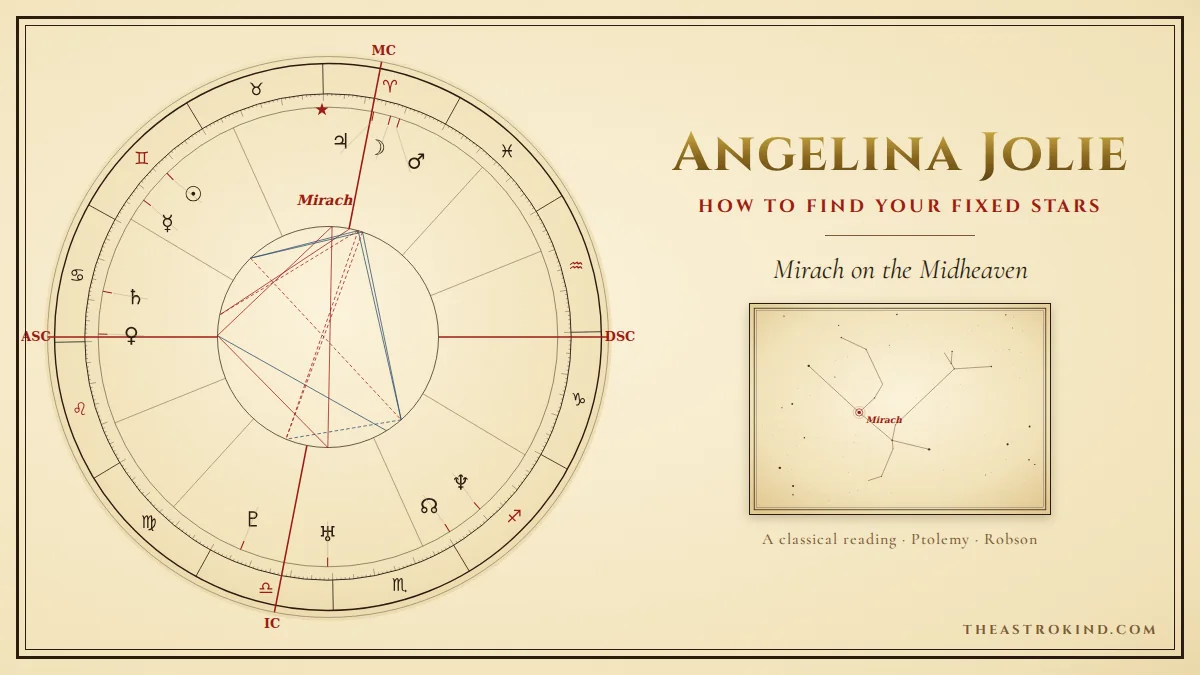
Fixed stars are the hidden precision of classical astrology. Unlike planets, they do not move quickly; they form the backdrop of the zodiac and, when they touch a sensitive point in a chart, they add a distinct and lasting tone. In this article I will explain the technique for locating them, the orbs involved, and how to judge a contact. Then we will apply it to a real chart: that of Angelina Jolie. You will see that the method is simple, but it demands rigour.
What are fixed stars and how are they calculated?
Fixed stars are the stars that keep their relative positions over centuries. In a natal chart, they are not interpreted as planets but as modifiers: they colour the planet or angle they touch. To find them, you need two things: the star's position and the correct orb.
The orb is the maximum distance at which a star is considered to be in contact with a planet or angle. The classical tradition assigns orbs according to the star's magnitude (its brightness). In this house we use a simple rule: for first-magnitude stars (magnitude 1.5 or brighter) the orb is 2°30′; for second-magnitude stars (up to 2.5) it is 1°30′; for the rest, 1°. Additionally, a star within 1°12′ of a point is said to be on the star – a decisive contact – while a star farther away but within its magnitude orb is only in orb, a secondary nuance.
There are two ways to measure the distance between a star and a point in the chart. The first is by ecliptic longitude, which is the usual way for planets. The second, and more precise for angles, is by right ascension and oblique ascension – that is, how the star actually rises or culminates on the equator. For the Midheaven and Ascendant, the latter method is preferred because it reflects the real geometry of the sky at the moment of birth.
Which stars matter most?
Not all contacts have the same weight. A first-magnitude star on a planet or angle is considered preferred and should be interpreted first. A second-magnitude star on the star is also strong, but slightly less so. Always check the magnitude before you interpret: a bright star will speak more loudly.
How to apply the technique to a real chart
Let us look at Angelina Jolie's chart (4 June 1975, 09:09, Los Angeles). We will focus only on three contacts that illustrate the method. The rest of the chart is covered in the full article (link at the end).
Midheaven on Mirach
The Midheaven is at 17° Aries. It is in contact with the star Mirach, of magnitude 2.1, with an orb of 0°36′. This contact is on the star and, because the star is second magnitude, it is a solid influence. Mirach is associated with beauty, charm and a certain public appeal. On the Midheaven, it adds a distinctive note to the career and public image.
Ascendant on Gomeisa
The Ascendant is at 28° Cancer. It is in contact with Gomeisa, of magnitude 2.9, with an orb of 0°43′. This is also on the star, though the star is fainter. Gomeisa is linked to a sharp intellect and a capacity for adaptation. On the Ascendant, it colours the personality and physical presence with a quick, perceptive quality.
Moon on Alpheratz
The Moon is at 13° Aries. It is in contact with Alpheratz, of magnitude 2.1, with an orb of 0°53′. This contact is on the star and is measured by ecliptic longitude, the correct method for a planet. Alpheratz is associated with independence, freedom and a love of movement. On the Moon, it adds emotional self-sufficiency and a need for personal space.
How to see this in your own chart
To find the fixed stars in your own natal chart, you need your birth data and a calculator that uses the correct orbs and the right method for angles. Start by identifying the stars that are on the star (within 1°12′). Then check their magnitude: a first-magnitude star will be more prominent. Finally, interpret the star in the context of the planet or angle it touches, using the classical meanings as a guide.
Remember that fixed stars are not fatalistic. They describe tendencies and tones, not inevitable events. Use them to add nuance and precision to your reading.
In practice
- Use the magnitude orb: 2°30′ for first magnitude, 1°30′ for second, 1° for the rest.
- Give priority to contacts within 1°12′ – those are on the star and are decisive.
- For the Midheaven and Ascendant, calculate by right ascension and oblique ascension; for planets, use ecliptic longitude.
- Interpret the star as a modifier of the planet or angle, not as a separate planet.
If you want to see the complete chart of Angelina Jolie with all its details, you can read the full analysis here: Angelina Jolie's natal chart.