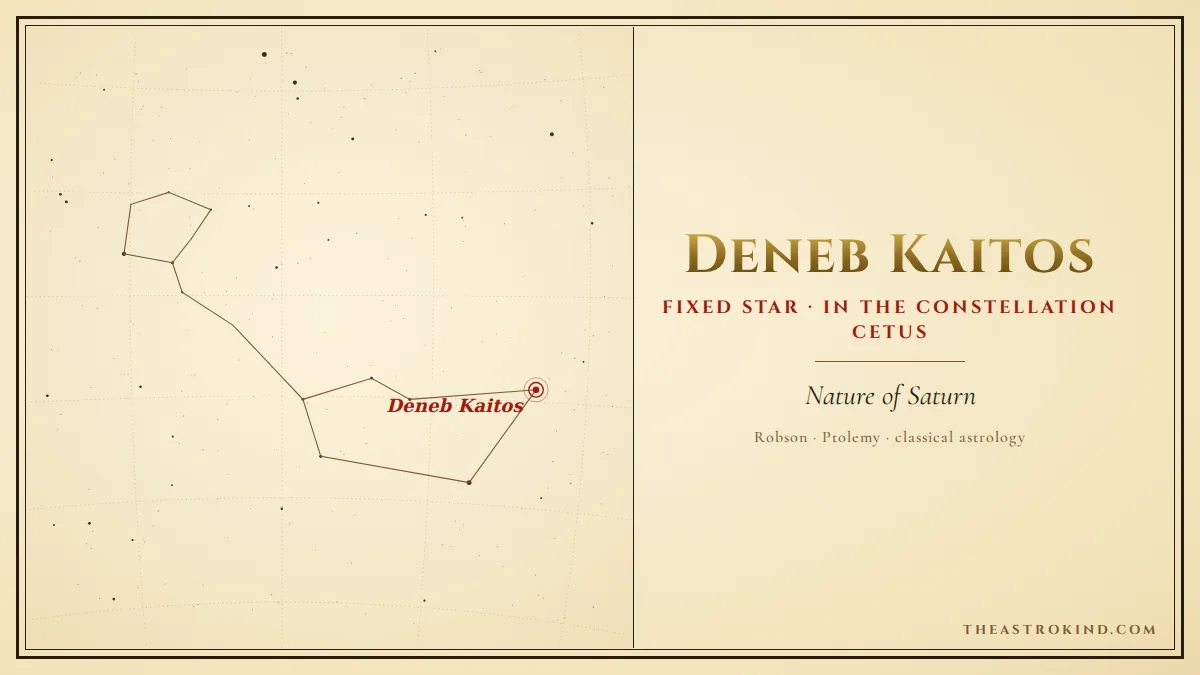
Deneb Kaitos, also known as Diphda, is a fixed star of the second magnitude in the constellation Cetus, the Sea Monster. It is the brightest star in Cetus and carries a distinctly Saturnine nature. In my three decades of practice, I have found that its influence is often misunderstood or overlooked, yet when prominent in a natal chart, it demands careful consideration. This article explains what Deneb Kaitos means in the natal chart, particularly when it is conjunct a planet or placed on an angle.
What is Deneb Kaitos?
Deneb Kaitos is located at approximately 2°17′ of Aries in the tropical zodiac (for the year 2000). It is a star of the nature of Saturn, according to the classical tradition. Vivian Robson, in his Fixed Stars and Constellations in Astrology, describes it as: “Self-destruction, inhibition, sickness. Compulsory migrations and changes, connected to a life of isolation.” This description is stark, but it must be understood within the context of the whole chart.
The star’s name comes from the Arabic Al Dhanab al Ḳaiṭos, meaning “the Tail of the Whale.” It marks the tail of the sea monster in the sky. In astrological symbolism, the tail of a creature often signifies the end of matters, the final stages, or the consequences of actions. Thus, Deneb Kaitos is linked to endings, isolation, and the forced changes that life sometimes imposes.
Its Saturnine nature means it operates through restriction, limitation, and discipline. It is not a star of easy gifts; it demands responsibility and often brings tests of endurance. However, like all fixed stars, its expression depends on the planet it contacts and the overall condition of the chart.
Deneb Kaitos on the Angles
When Deneb Kaitos is conjunct an angle—the Ascendant, Midheaven, Descendant, or Imum Coeli—its influence is more immediate and visible in the native’s life. The angles are the most sensitive points of the chart, and a fixed star there will color the personality, the career, or the public image.
On the Ascendant
Deneb Kaitos on the Ascendant often indicates a person who experiences life as a series of compulsory changes. There may be a tendency toward isolation or a feeling of being an outsider. The native might struggle with self-destructive patterns or have a predisposition to melancholy. Physical health can be delicate, particularly in the early years. However, this placement can also give great endurance and the ability to rebuild after setbacks.
On the Midheaven
On the Midheaven, Deneb Kaitos can signify a career marked by sudden changes, forced relocations, or periods of isolation. The native may work in fields that involve confinement, such as research, medicine, or monastic life. There can be a sense of being called to a path that requires sacrifice. Public recognition may come late or be accompanied by controversy. It is crucial to avoid impulsive career decisions, as the star tends to bring consequences that are hard to reverse.
On the Descendant and Imum Coeli
On the Descendant, Deneb Kaitos may manifest in relationships as a pattern of separation or isolation. Partnerships might be subject to compulsory changes, or the native may attract partners who are solitary or burdened. On the Imum Coeli, it can indicate a home life marked by restriction, or a family history of migration and uprooting. The roots may be severed, leading to a sense of not belonging.
Deneb Kaitos Conjunct a Planet
When Deneb Kaitos is conjunct a planet, it modifies that planet’s expression according to its Saturnine nature. The orb should be kept tight—no more than 1° to 2° for a noticeable effect. The planet’s own nature and dignity will determine how the star’s influence is channeled.
Conjunctions with Personal Planets
Sun conjunct Deneb Kaitos: The identity is marked by a sense of duty and isolation. The native may feel compelled to take on burdens that others avoid. There can be a tendency toward self-denial or a life of service. The father may be absent or distant.
Moon conjunct Deneb Kaitos: The emotional life is characterized by inhibition and a fear of change. The native may experience compulsory relocations in childhood, leading to a sense of emotional insecurity. There can be a predisposition to melancholy or psychosomatic illness.
Mercury conjunct Deneb Kaitos: The mind is serious and inclined toward solitary study. Communication may be inhibited, or the native may prefer to work in isolation. There can be an interest in esoteric or mundane subjects.
Venus conjunct Deneb Kaitos: Relationships are often accompanied by sacrifice or separation. The native may be drawn to partners who are unavailable or who require care. Artistic expression may be tinged with melancholy.
Mars conjunct Deneb Kaitos: The drive is tempered by restriction. The native may experience frustration or forced inaction. There is a risk of accidents or surgery, particularly if Mars is afflicted.
Conjunctions with Social and Outer Planets
Jupiter conjunct Deneb Kaitos: The expansive nature of Jupiter is curtailed. The native may find that opportunities are limited or that growth requires isolation. There can be a philosophical or religious dimension to the sense of duty.
Saturn conjunct Deneb Kaitos: This is a powerful combination, as both are Saturnine. It can indicate a life of strict discipline, asceticism, or confinement. The native may be drawn to solitary professions or have a fear of self-expression. However, it can also give great perseverance and the ability to endure hardship.
Uranus, Neptune, Pluto conjunct Deneb Kaitos: These generational planets move slowly, so their conjunction with Deneb Kaitos affects entire cohorts. When prominent in a natal chart, they can indicate collective experiences of forced migration, isolation, or societal restrictions. The individual may feel the weight of these themes personally.
How to Interpret Deneb Kaitos in the Natal Chart
To judge the influence of Deneb Kaitos, consider the following steps:
- Check the orb: Only conjunctions within 1°-2° are significant. A wider orb dilutes the effect.
- Assess the planet’s condition: A dignified planet can channel the star’s energy constructively; a debilitated planet may struggle.
- Look at the house: The house placement shows the area of life where isolation or compulsory change occurs.
- Consider the whole chart: Deneb Kaitos does not act alone. Its influence is modified by aspects and other fixed stars.
In my experience, Deneb Kaitos is not a “malefic” star in the simplistic sense. It is a star of testing, and those who meet its challenges with patience and discipline can achieve great inner strength. It often marks individuals who are called to walk a solitary path, but who, in doing so, develop a profound understanding of life’s limitations.
In practice
- When Deneb Kaitos is conjunct a planet, note the planet’s dignity and house placement to see where isolation or compulsory change manifests.
- On an angle, it brings visible life themes: the Ascendant for personality and health, the Midheaven for career and public status.
- Pay attention to transits of Saturn or Mars to Deneb Kaitos, as they often trigger its themes of restriction and forced adaptation.
- Always consider the native’s free will and other chart factors; Deneb Kaitos indicates challenges, not inevitable doom.