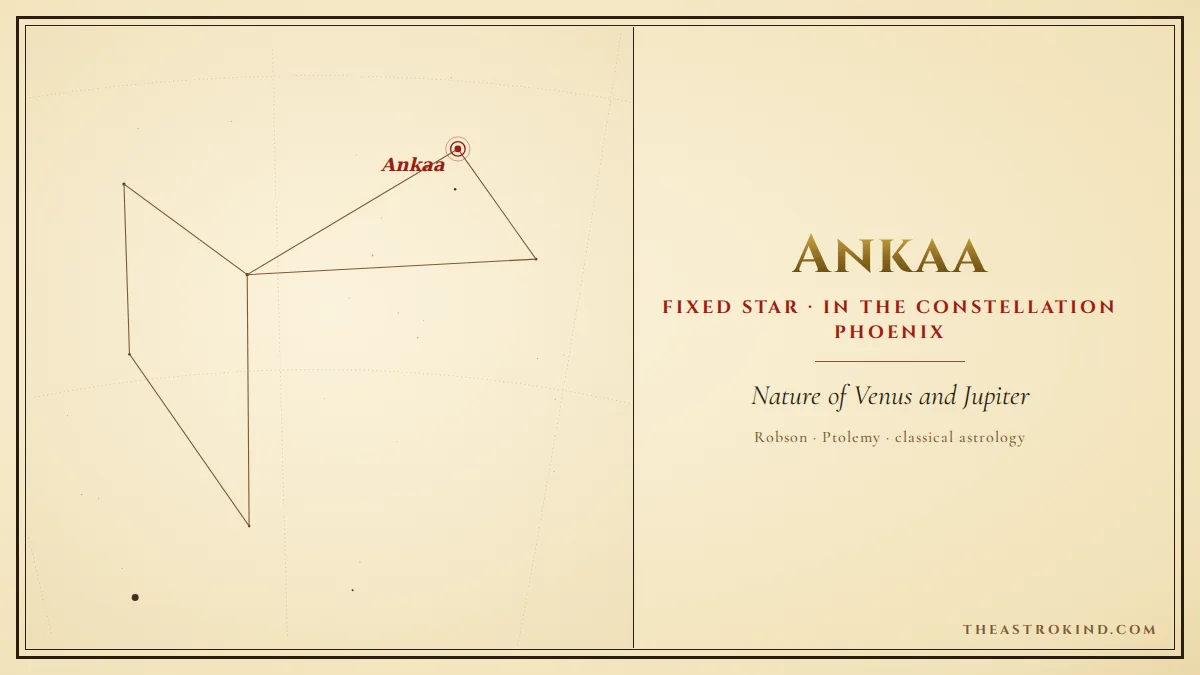
Ankaa (Alpha Phoenicis) is a star of the second magnitude in the constellation Phoenix, and one of the few southern fixed stars that deserves more attention than it usually receives. Robson summarised its nature with unusual precision: transformation through suffering, regeneration and renewal, and a pioneering spirit rising from adversity. In my three decades of practice I have found that description accurate, but only when the star is properly placed and properly aspected. A fixed star does nothing by itself. It colours what the chart already promises.
What Ankaa Is, Astronomically and Symbolically
Ankaa sits at roughly 1° of Pisces by modern precession (about 2° Aries in older texts, depending on the ayanamsa and the epoch used). It is the brightest star of Phoenix, a southern constellation invisible from most of Europe and North America. This matters: many classical authors, Lilly included, never saw it and never used it. Its interpretation rests largely on the Robson tradition and on the symbolism of the constellation itself.
The star is of the nature of Venus and Jupiter. That combination is benefic, but not soft. Venus gives attraction, harmony and the capacity to rebuild relationships; Jupiter gives expansion, faith and the philosophical frame that turns a crisis into a lesson. Together they describe someone who recovers well, who grows through what breaks them, and who tends to emerge from difficulty with more, not less, than they had before.
The Phoenix symbolism is not decorative. It is the core of the delineation. This is a star of the survivor who does not merely survive but reconstitutes themselves on better terms. The danger is romanticising suffering. Ankaa does not reward pain; it rewards the rebuilding that follows it.
Ankaa in the Natal Chart: The Core Signature
When Ankaa is prominent in a natal chart, the biography usually contains at least one clear rupture followed by a visible reconstruction. Not a small setback — a genuine break with a former life: a career collapse, an emigration, a loss that forces a new identity. The person does not return to the previous form. They return as something else.
There is also a pioneering quality. Ankaa natives often start things after others have given up, or in fields where no clear path exists. The Venus-Jupiter nature means this pioneering is rarely aggressive; it is persuasive, strategic, and often built on relationships and patronage rather than force.
Robson's phrase "rising from adversity" should be read literally. The chart usually shows the adversity somewhere — a hard Saturn, an afflicted Moon, a difficult twelfth-house placement — and Ankaa shows the recovery mechanism. The star does not create the wound. It describes the phoenix.
Ankaa on the Angles
On the Ascendant, Ankaa gives a resilient persona and a life shaped by visible reinvention. Others often meet the person after a transformation and never see the earlier version. The physical constitution tends to recover well from illness, though the native may push too hard during recovery.
On the Midheaven, the star marks a public career built in stages, often with a conspicuous break and a second, stronger phase. Reputation is rebuilt rather than inherited. This is common in reformers, founders who return after failure, and public figures whose credibility comes from having been through something.
On the Descendant, Ankaa tends to appear through partners: relationships that end and reform, or a partner who is themselves a phoenix figure. On the Imum Coeli, it points to family or ancestral patterns of loss and rebuilding, often across generations or through migration.
Ankaa Conjunct a Planet
Conjunct the Sun, Ankaa gives a life narrative of renewal and a strong instinct for starting over. Conjunct the Moon, it shows emotional resilience and a habit of processing grief into something constructive — though also a tendency to dramatise the past.
With Mercury, the mind works well under pressure and the native communicates recovery stories persuasively. With Venus, relationships and finances tend to be rebuilt after loss, sometimes more than once. With Mars, the pioneering side is sharper: the native fights to regenerate and can be impatient with those who will not.
With Jupiter, the philosophical frame is strong — the person makes meaning from hardship and often teaches it. With Saturn, the adversity is heavier and the rebuilding slower, but the result is durable. With the outer planets, treat the contact cautiously; a 1° orb to a fixed star is already generous, and anything wider is noise.
Orbs and Judgement
Use no more than 1° for a conjunction to a planet or angle, and prefer 30 minutes of arc for the most reliable reading. Ankaa is a second-magnitude star, so it is not as forceful as Regulus or Algol, but it is not negligible either. Always check whether the planet is angular, dignified, and well aspected. A weak planet on Ankaa produces the suffering without the regeneration.
Do not read the star in isolation. The classical rule holds: the star confirms and colours, it does not create. If the natal chart shows no capacity for recovery — a badly damaged Ascendant ruler, for instance — Ankaa will describe repeated crises rather than triumph over them.
In practice
- Keep the orb tight: 1° maximum, 30 arcminutes for confidence.
- Read Ankaa as a recovery mechanism, not a source of misfortune.
- Check the host planet's dignity and aspects before judging the outcome.
- Look for a documented rupture-and-rebuilding pattern in the biography.
→ Calculate your fixed stars with our fixed stars calculator