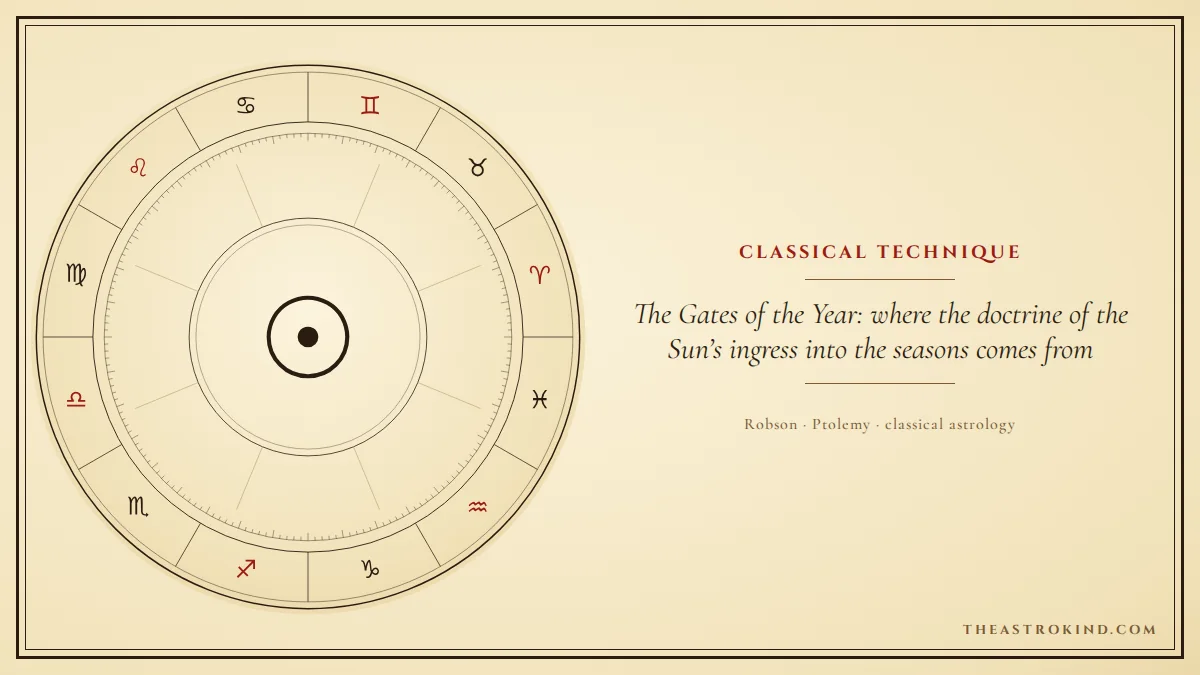
Four times a year the Sun crosses a frontier: it enters Aries at the March equinox, Cancer at the June solstice, Libra at the September equinox and Capricorn at the December solstice. Many people today call these moments “the gates of the year”. The idea is old, but not quite as it is told on the internet. Here we separate what the classical texts say from what was added later.
The name: two gates, not four
The image of the “gates” comes from ancient philosophy, not from practical astrology. The philosopher Porphyry (3rd century), in The Cave of the Nymphs, records a teaching of Numenius: the two solstices are two gates of heaven. Through Cancer souls would descend to be born, and through Capricorn they would rise. Around the year 400, Macrobius, in his Commentary on the Dream of Scipio, calls them the “gates of the Sun”.
Notice two things: there were only two, the solstices, and they spoke of the soul, not of daily life or of the year.
Astrological practice: the year begins with the Sun in Aries
The entry of the Sun into the seasons becomes a technique in the astrology of the world, which judged the year of peoples, harvests and governments. Ptolemy, in Book II of the Tetrabiblos, explains that the four points where the seasons begin open each season, and teaches how to forecast it from the new or full Moon that precedes them.
Arabic-speaking astrologers such as Masha'allah and Albumasar made it a complete method: the revolution of the year of the world. The chart is cast for the exact instant the Sun enters Aries, and in it one looks for the planet that rules the year.
Bonatti: the method step by step
The Italian astrologer Guido Bonatti (13th century) gathered that whole tradition in his Liber astronomiae. We work with the Basel edition of 1550, and these are his rules on the gates, with their column:
- How the lord of the year is found (ch. I, cols. 490-494). It begins: “Postquam certificatus fueris ad unguem de tempore introitus Solis in Arietem…”, “once you have made certain to the last detail of the time of the Sun’s entry into Aries…”. Bonatti looks first at the ruler of the Ascendant: if it is near the line of the Ascendant (three degrees before or four after), direct and free of combustion, it is the lord of the year. If not, he tries the exaltation ruler, the luminary of the sect, the term ruler and the triplicity ruler, and then does the same in houses 10, 7, 4, 11, 9, 5 and 3, in that order.
- How long the chart rules: this is where the four gates are born (ch. XXIIII, col. 527). If a fixed sign rises at the Sun’s entry into Aries, “continet enim illa revolutio in se omnes quartas illius anni”: the chart contains all the quarters of the year. If a common (double) sign rises, it only rules “per medietatem illius anni, scilicet usque ad introitum Solis in Libram”, until the Sun enters Libra. And if a movable sign rises, it only lasts until the entry into Cancer, “et tunc oportebit te quaerere omnes quartas anni”: then all four gates must be cast, and each has its own lord.
- Which place it applies to (chs. I and V). Bonatti says the significations will be stronger or weaker “in anno illo, seu medietate, vel quarta illa, in regionibus super quibus fuerit revolutio illa”: in that year, that half or that quarter, in the regions for which the chart was cast. In ch. V he tells us to take the Ascendant “secundum ascensiones civitatis seu regionis in qua fueris”, according to the city or region where you are, and explains how its signification extends east and west.
- How the earth is divided (ch. VIII). The inhabited earth is divided into seven climes, bands of latitude, and each is given to a planet: the first to Saturn, the second to Jupiter, the third to Mars, the fourth to the Sun, the fifth to Venus, the sixth to Mercury and the seventh to the Moon.
Another classic, Haly Abenragel (11th century), teaches that the revolution of the year is considered “per cathedram regis”, that is, cast for the seat of the king: the capital of the country.
Beware of another “gate”
In the same book Bonatti has a chapter titled “De apertione portarum secundum Alchabitium”, “the opening of the gates according to Alcabitius” (col. 816). It has nothing to do with the seasons: it is a technique for weather and rain, which watches when the planets ruling opposite signs aspect each other. It shares the word, not the meaning.
What is not classical
The “four gates” as spiritual portals that open at each solstice and equinox come above all from the 20th century, from authors such as René Guénon and from the New Age movement. It may be a beautiful idea, but it is not in Ptolemy, Albumasar or Bonatti.
How we calculate it at TheAstroKind
In The Gates of the Year we calculate the exact instant of each solar ingress with NASA ephemerides, cast the chart for your city and for the capital of your country, and find the lord of the year or of the season with Bonatti’s procedure. Houses are calculated by Alcabitius, the system medieval Latin astrologers used, and we also show you the result with Placidus, the most used system today. Every judgement carries its citation so you can check it.
What these texts say is the history and doctrine of classical astrology: it is not a certain prediction, nor medical, legal or financial advice.