This is a clean, apolitical astrological examination of the fixed stars in the natal chart of James Talarico. It takes no side, it is not an opinion for or against him or his party, and it does not predict any election. One technical caveat must be stated at the outset: the birth time is not known with certainty, and the chart is cast for an approximate 12:00 local time. For that reason I will not draw conclusions from the Ascendant, the Midheaven, the houses, the stars on the angles, the Part of Fortune, or the exact degree of the Moon, which moves roughly thirteen degrees a day. The reading rests on fixed-star conjunctions to the Sun and the slow planets, which hold for the whole day.
Why the Fixed Stars Still Matter
The fixed stars are the oldest layer of astrological meaning we possess. Long before the twelve signs were fixed to the ecliptic, Babylonian and Egyptian observers read the sky by its bright stars. Ptolemy, in the Tetrabiblos, treated them as a distinct and powerful order of causation, and Vivian Robson's Fixed Stars and Constellations in Astrology (1923) remains the standard reference in the English tradition. In my thirty years of practice I have found that a tight star conjunction to a luminary or a slow planet marks a permanent trait of character, not a passing mood.
What follows is a survey of the notable conjunctions in this chart, star by star, with the nature assigned by Ptolemy and Robson and the promise the classical tradition attaches to each. Where several stars fall on the same planet, I read them as a single combined testimony.
The Sun on Algol: Intensity Under Control
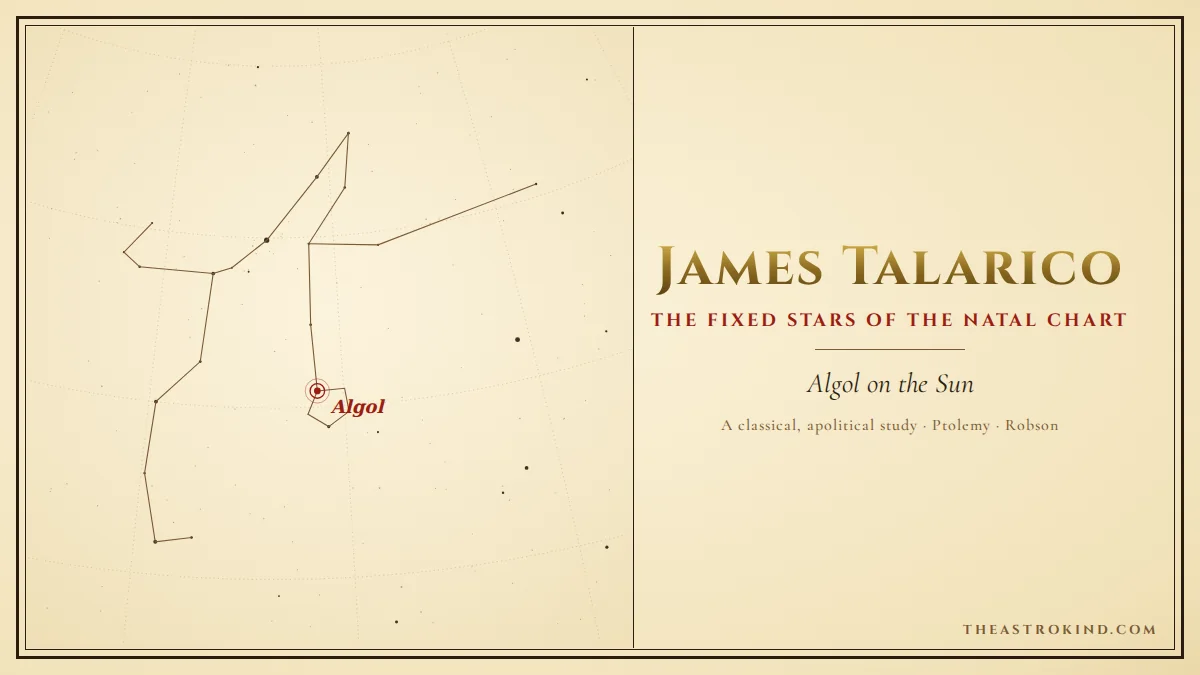
The Sun sits at 26° Taurus, within 0.74° of Algol, the Head of Medusa. Robson gives Algol the nature of Saturn and Jupiter, and describes it as a star of immense passional force, emotional intensity and overflowing intuitive intelligence, which demands a high degree of self-control if the native is to convert obstacles into great conquests. This is the single most important fixed-star contact in the chart, because it falls on the Sun, the luminary of vocation, and the Sun is also lord of the Ascendant placed in the tenth house of public standing.
Algol is not a gentle star, and the tradition is honest about that. But it is not a curse either. Read soberly, it marks a person whose public identity is bound up with intense feeling and with the discipline required to master it. The Sun is peregrine in Taurus, neither dignified nor debilitated, which fits the classical picture of a force that must be trained rather than one that acts automatically.
The Moon on Spica and Arcturus: Talent and Earned Honor
The Moon at 2° Libra is conjunct Spica within 1.06° and Arcturus within 1.45°. Robson assigns Spica the nature of Venus and Mars and calls it a source of superlative talent in creative, scientific and spiritual fields, with a luminous and constant protection against misfortune so long as integrity is maintained. Arcturus, of the nature of Jupiter and Mars, promises wealth accumulated through steady work, public honors and respected leadership.
Two benefic stars on the Moon, and the Moon is in Libra, a sign of air and of relation. The classical reading is straightforward: a temperament that attracts recognition through talent and sustained effort rather than through sudden fortune. The Moon is peregrine and rules the twelfth house, so the tradition also notes a private or hidden dimension to the emotional life, but the stars on it are protective, not malefic.
Saturn, Neptune and the Stars of the Archer
Saturn at 10° Capricorn is conjunct Ascella within 0.04°, an extraordinarily tight contact. Robson gives Ascella the nature of Jupiter and Mercury and promises good fortune, happiness and lasting success. Saturn is in its own domicile here, which the classical authors read as a planet able to realize the advantages of its house with ease. The same Saturn is also conjunct Nunki (1.21°), a star of veracity, optimism, religious spirit and governmental authority, and Manubrium (1.40°), which speaks of heroism and of great achievements won at personal cost.
Neptune at 10° Capricorn is conjunct Nunki within 0.14° and Ascella within 1.39°, reinforcing the same testimony. Nunki is one of the few stars Robson explicitly links to authority of government, and its double contact with Saturn and Neptune is the strongest single theme in the chart. Saturn and Neptune are also conjunct each other within 1.35°, so the two planets and their stars speak with one voice: a vocation of public responsibility, sober, idealistic, and durable.
Uranus on the Stars of the Archer's Bow
Uranus at 4° Capricorn is conjunct Kaus Australis (0.18°), Kaus Media (0.32°) and Kaus Borealis (1.41°). Robson assigns all three the nature of Jupiter and Mars and describes them as stars of ascent, idealistic nature, influential leadership, keen perception and the search for truth. Kaus Media adds honors, wealth and success through mental capacity. Uranus is peregrine, so the star contact is the principal testimony here, and it points to a reformist, idealistic streak in the public character.
Uranus also forms a partile trine to the Midheaven, but since the birth time is approximate I will not press that point. The star contacts to Uranus itself, however, hold for the whole day.
Venus on Ain, Mercury on the Hyades
Venus at 7° Gemini is conjunct Ain within 0.40°. Robson gives Ain the nature of Venus and the Moon and describes sudden honors followed by disgrace, military advancement, and a pioneering role in new movements. This is a cautionary star, and the classical authors read it as a warning against the instability of sudden elevation. Venus is peregrine and rules the tenth house, so the warning is attached to public standing.
Mercury at 5° Gemini is conjunct Prima Hyadum within 0.16°, a very tight contact. Robson assigns the Hyades the nature of Saturn and Mercury and warns of tears, sudden events, violence, dishonor and a scandalous reputation when the star is angular or with a luminary. Mercury here is in its own domicile and rules the second and eleventh houses, so the tradition reads it as a strong but ambivalent testimony: great communicative power shadowed by the risk of public controversy.
Two further contacts deserve mention. Chiron at 3° Cancer is conjunct Tejat (0.51°) and Propus (1.35°), stars of force, energy, protection and eminence. Pluto at 12° Scorpio is conjunct Menkent (1.27°) and Alphecca (1.29°), stars of learning, philosophy and enduring honor won through patient merit. Both reinforce the picture of a public life built on study and sustained effort.
Practical takeaway
- The dominant fixed-star theme is Saturn and Neptune on Ascella and Nunki: lasting success, veracity and governmental authority, soberly earned.
- The Sun on Algol marks intense passional force and intuitive intelligence that require self-control to become constructive.
- The Moon on Spica and Arcturus promises talent and public honor through steady work and maintained integrity.
- Venus on Ain and Mercury on the Hyades are the cautionary notes: sudden elevation and public controversy are the classical risks attached to the tenth-house significators.
Read as a whole, the fixed stars in the natal chart of James Talarico describe a public temperament built on discipline, study and idealistic conviction, with the classical warnings that accompany any prominent tenth-house configuration. The stars promise character and public standing; they do not decide elections, and no honest astrologer should claim otherwise.