This is a clean, apolitical astrological examination of the fixed stars in the natal chart of Gavin Newsom. It takes no side, it is not an opinion for or against him or his party, and it does not predict any election. The birth time is not known with certainty; the chart uses an approximate time of 12:00 local. For that reason, I do not draw conclusions from the Ascendant, Midheaven, houses, stars on the angles, the Part of Fortune, or the exact degree of the Moon, which moves about 13 degrees a day. The reading rests on fixed-star conjunctions to the Sun and the slow planets, which hold for the whole day.
What follows is a practical summary of the fixed stars in the natal chart of Gavin Newsom, judged by the doctrine of Ptolemy, Vivian Robson (1923), and the classical tradition. I have observed that fixed stars add a permanent, almost fated tone to a planet's expression. They do not override the planet; they colour it.
The Royal Stars: Regulus and Antares
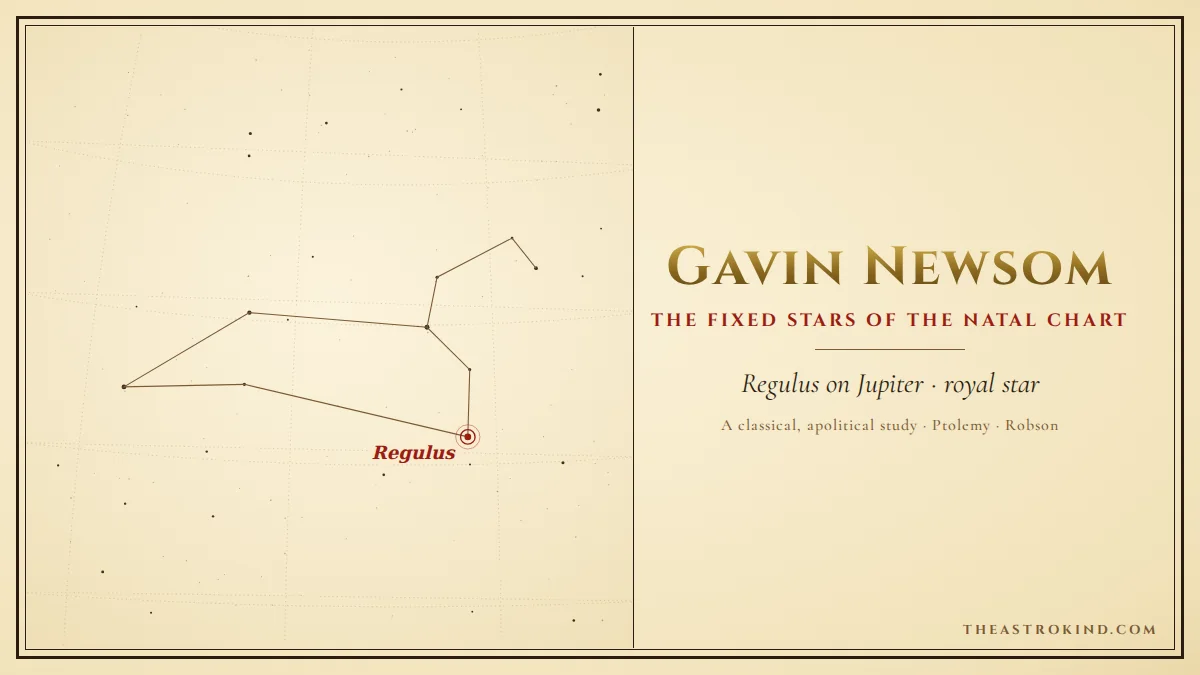
Two of the four Royal Stars of Persian tradition touch this chart. The first is Regulus, the Heart of the Lion, at 0.85° conjunction with Jupiter in Leo. Robson gives Regulus the nature of Mars and Jupiter: glorious conquests, great fortune, leadership, nobility, a meteoric rise. But he adds a strict warning: to keep that greatness, the native must avoid revenge. Jupiter here is also peregrine and rules the Ascendant, so the star lends its royal tone to the whole life direction.
The second is Antares, the Heart of the Scorpion, at 1.85° conjunction with the Ascendant. Because the birth time is uncertain, I treat this contact with caution. Robson describes Antares as Mars-Jupiter: colossal courage, fiery passion, success in struggle, with a warning against impulsiveness and obsession. If the time is close to noon, this star would sit on the rising degree, giving a martial, combative public persona.
Mercury's Cluster of Stars
Mercury in Scorpio carries an unusual load. It conjoins Menkent (0.07°), nature of Venus: scholarship, learning, philosophy, steady devotion. It conjoins Alphecca (0.10°), Venus-Mercury: honour, dignity, artistic or poetic talent, lasting success through patient merit. It conjoins Acrux (0.51°), nature of Jupiter: ceremony, justice, mysticism. And it conjoins Mimosa (0.74°), Jupiter-Venus: astrology, prophecy, ancient wisdom.
This is a Mercury of deep study and ceremonial mind, not a shallow communicator. Robson's doctrine suggests a talent for law, philosophy, or ritual eloquence. Mercury is peregrine and rules the 7th house, so these gifts express through public dealings and partnerships.
Saturn, Pluto, and the Harder Stars
Saturn in Aries conjoins Algenib (0.29°), nature of Mars and Mercury. Robson is blunt: dishonour, violence, misfortune, the anger of the multitude, notoriety, and a sharp intellect used for ill. This is a difficult star, and Saturn is in fall in Aries. It does not predict events, but it warns of public hostility and a heavy burden in the house of home and foundations.
Pluto in Virgo conjoins Denebola (0.24°), Saturn-Venus: an independent spirit, quick judgement, leadership, with a caution against hasty decisions. Pluto also conjoins Uranus in the same sign, so this star colours a generational, reformist impulse.
Jupiter's Other Stars
Jupiter also conjoins Algieba (0.63°), Saturn-Mars: boldness and valour joined to a generous, noble spirit, linked to military or legal eminence. And Phecda (1.50°), nature of Mars: lust, excess, boastfulness, destructive cruelty. The wider orb makes Phecda weaker, but it is present. Jupiter is peregrine, so these stars act as a mixed blessing: eminence with a shadow of excess.
Supporting Stars and the Lunar Nodes
Uranus conjoins Zavijava (0.48°), Mercury-Mars: strength of character, business capacity, a powerful and just nature. Neptune conjoins Agena (0.57°), Venus-Jupiter: honour, friendship, refinement, morality, distinction. The Sun conjoins Seginus (0.41°), Mercury-Saturn: losses through friends and associations, a subtle mind for business. The Sun is in fall in Libra and rules the 9th, so this star touches foreign affairs, law, and higher learning.
The nodes add their own testimony. Caput Draconis in Aries trines Jupiter (0.52°), amplifying the 4th house of home and roots. Cauda Draconis in Libra conjoins the Sun's sign, diminishing the 10th house of career. Bonatti and Lilly teach that the North Node amplifies and the South Node diminishes. Here the career house is quietly reduced while the domestic and ideological houses are strengthened.
How the Stars Combine
The dominant pattern is a Jupiter-Mercury axis loaded with royal and scholarly stars. Regulus on Jupiter promises eminence; Alphecca, Acrux, and Mimosa on Mercury promise learning, justice, and mystical depth. Against this, Saturn on Algenib warns of public anger and notoriety, and the Sun on Seginus warns of losses through associates. The chart is not simple: it is a contest between royal elevation and public friction.
In my thirty years of practice, I have seen this combination in figures who rise through eloquence and law, but who attract fierce opposition. The stars do not decide politics; they describe the stage on which the person acts.
Practical takeaway
- Regulus on Jupiter is the strongest royal signature: leadership and eminence, with Robson's warning against revenge.
- Mercury's cluster (Menkent, Alphecca, Acrux, Mimosa) gives a scholarly, ceremonial, and strategic mind.
- Saturn on Algenib and the Sun on Seginus warn of public hostility and losses through associates.
- Antares on the Ascendant is suggestive but uncertain, since the birth time is approximate.
To explore your own fixed stars and planetary conjunctions, cast your chart and see which stars touch your Sun, Moon, and angles.