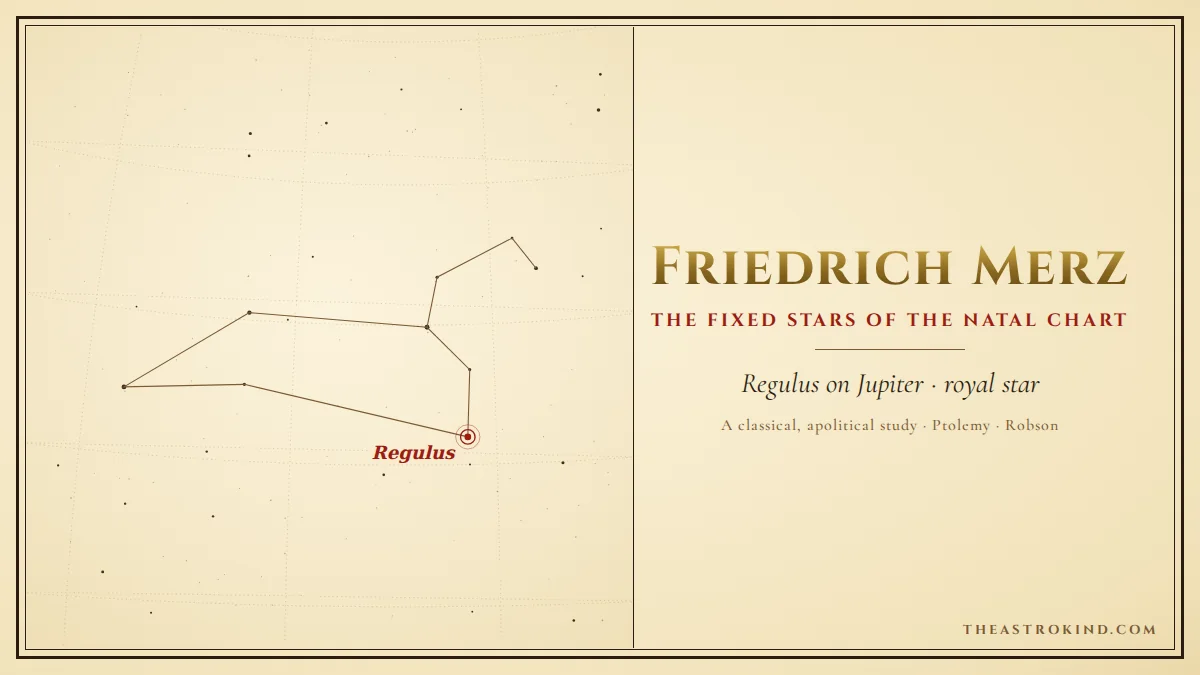
This is a clean, apolitical astrological examination of the fixed stars in the natal chart of Friedrich Merz. It takes no side, it is not an opinion for or against him or his party, and it does not predict any election. One technical caveat before we begin: the birth time is not known with certainty, and the chart used here rests on an approximate time of 12:00 local. For that reason I will not draw conclusions from the Ascendant, the Midheaven, the houses, the stars on the angles, the Part of Fortune or the exact degree of the Moon, which moves about thirteen degrees a day. The reading rests on fixed-star conjunctions to the Sun and the slow planets, which hold for the whole day.
Why the Fixed Stars Still Matter
Vivian Robson, in his Fixed Stars and Constellations in Astrology (1923), reminds us that the stars do not act alone. They colour and qualify the planet they touch, and the planet remains the agent. This is also the doctrine of Ptolemy in the Tetrabiblos and of Bonatti in the Liber Astronomiae: the star is a condition, not a cause.
In the chart of Friedrich Merz, several slow planets sit within a degree of major stars. That is unusually dense. When we study the fixed stars in the natal chart of Friedrich Merz, we are looking at a chart where the stellar background is not decorative but structural.
Regulus: Jupiter and Pluto in Leo
Jupiter at 0.21° and Pluto at 0.70° from Regulus, the Heart of the Lion, is the loudest statement in this chart. Robson gives Regulus the nature of Mars and Jupiter: glorious conquests, great fortune, leadership and nobility. He also adds a strict warning — avoid revenge, or the greatness will not last.
Both planets are in Leo, the sign the star governs, and both are in the seventh house. The classical tradition reads this as a public-facing eminence: the native is seen, judged and honoured in the sphere of others. Morin's Theorem 78 places Jupiter peregrine here, which tempers the promise — the elevation comes, but not from inherited dignity. It must be earned in the open.
Jupiter also conjoins Algieba (0.43°), a Saturn-Mars star of boldness joined to a generous spirit, and Phecda (0.43°), which Robson calls boastful and destructive when unchecked. The combination is a classical portrait of a man whose ambition is visible and whose restraint is the price of his standing.
Saturn on Agena
Saturn at 0.02° from Agena is the tightest contact in the chart. Robson assigns Agena the nature of Venus and Jupiter: honour, friendship, refinement, morality, health and distinction. It is a benign star, and it falls on Saturn, the lord of the first house by Capricorn rising — though I will not press the Ascendant, since the birth time is uncertain.
What we can say is that Saturn, the planet of structure and endurance, is dignified by a star of moral distinction. In the tenth house, Saturn carries the weight of public office. The star softens the harshness of Saturn without removing its seriousness. This is the signature of a career built on discipline and reputation rather than charisma.
The Sun and the Royal Stars
The Sun at 0.47° from Zuben Eschamali is a Júpiter-Mercury star of great ambition, political success, social distinction and brilliant intellect. Robson is explicit: it elevates the status of the individual. The Sun is also conjunct the Midheaven, but since the birth time is approximate, I read the star contact rather than the angle.
The Sun is peregrine by Morin's Theorem 78, and it is conjunct Saturn at 4.87°. The stellar promise of elevation is therefore qualified by Saturnian gravity. The tradition would say the honours arrive, but slowly, and with responsibility attached.
Antares and Alniyat on Venus
Venus at 2.43° from Antares, the Heart of the Scorpion, is a wide but real contact. Robson gives Antares the nature of Mars and Jupiter: colossal courage, fiery passion, success in struggle — with the warning to avoid impulsiveness and obsession. Venus also conjoins Alniyat (0.47°), a Mars-Saturn star of a warrior nature.
Venus is in Sagittarius in the eleventh house, peregrine. The star does not make Venus gentle; it makes her combative in the sphere of alliances and factions. The classical reading is a man who fights for his circle, and whose friendships are tested by fire.
Minor Contacts and the Wider Picture
Mercury at 1.16° from Gacrux, a Jupiter star of justice and ceremony, adds a note of principle to a Mercury that Morin places peregrine in Scorpio. The Moon at 0.88° from Algorab, a Mars-Saturn star Robson describes harshly, is the one contact I would flag with caution — but the Moon's exact degree is unreliable with an approximate birth time, so I do not build on it.
What emerges is a chart where the fixed stars reinforce a single theme: elevation through struggle, honour through discipline, and a public life lived under the gaze of Regulus and Antares, the two royal stars of the Lion and the Scorpion. Robson's warnings are not predictions; they are the classical conditions attached to greatness.
In practice
- Read the star through the planet: Regulus on Jupiter promises eminence, but only if revenge is avoided.
- Agena on Saturn is a benign contact — it dignifies structure and reputation.
- Zuben Eschamali on the Sun elevates status through intellect and ambition.
- Antares on Venus warns against obsession in alliances; courage must be disciplined.
The fixed stars in the natal chart of Friedrich Merz describe a public character shaped by royal stars and moral ones, with the classical conditions of restraint and endurance written into the promise.