This is a clean, apolitical astrological examination of the fixed stars in the natal chart of Bernie Sanders. It takes no side; it is not an opinion for or against him or his party, and it does not predict any election, trial, scandal, illness or death. It simply reads what the fixed stars promise in character and public life, as the tradition describes them. One caution before we begin: the birth time is not known with certainty — the chart is cast for an approximate 12:00 local time. For that reason I will not draw conclusions from the Ascendant, the Midheaven, the houses, the stars on the angles, the Part of Fortune, or the exact degree of the Moon, which moves about 13 degrees a day. The reading rests on fixed-star conjunctions to the Sun and the slow planets, which hold for the whole day.
Why the Fixed Stars Matter Here
In the tradition of Ptolemy, Robson and Lilly, the fixed stars are not ornaments. They are the oldest layer of the zodiac, and when a star conjoins a planet within a degree or so, it colours that planet's expression with a specific, unmistakable tone. Robson's Fixed Stars and Constellations in Astrology (1923) is the reference I follow here, and the orbs in this chart are tight — several under one degree.
What strikes me immediately is the density of contacts. The Sun, Venus, Jupiter, Saturn, Uranus, Neptune and the nodes all sit on notable stars. This is not a chart where the fixed stars whisper; they speak. In my thirty years of practice, I have observed that charts with this many close stellar conjunctions tend to produce lives that are unusually public and unusually polarising — the stars do not grant neutrality.
The Sun on Alcor and Mizar
The Sun in Virgo conjoins Alcor (orb 0.55°) and Mizar (orb 0.72°), both of the nature of Mars. Robson calls Alcor the ancient test of vision — a star of sharp perception and intuition. Mizar, he says, gives leadership and courage but carries a warning about fire and catastrophe. Together they mark a solar identity built on keen sight and combative resolve.
Because the Sun is peregrine (Morin, Theorem 78), it holds a middle state — neither dignified nor debilitated. The stars therefore do not elevate the Sun to honours by themselves; they sharpen it. The result is a temperament that sees clearly and fights openly, without the cushion of a dignified luminary.
Venus: The Most Fortunate Contact
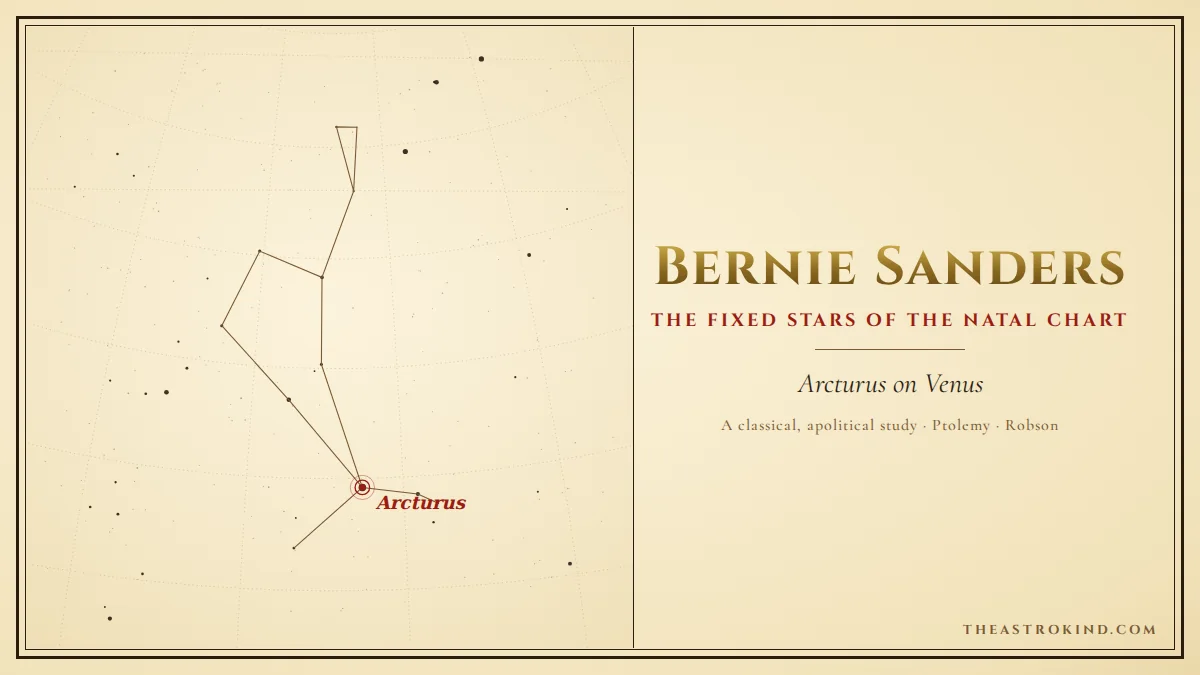
Venus in Libra is in her own domicile (Morin, Theorem 35) and conjoins Spica (orb 0.73°), Arcturus (orb 1.12°) and Nekkar (orb 1.13°). This is the strongest stellar cluster in the chart.
Spica, of the nature of Venus and Mars, is the classic promise of superlative talent and a luminous protection against misfortune, provided integrity is kept. Arcturus adds wealth gathered through steady work, public honours and respected leadership. Nekkar, of Saturn and Mercury, introduces a harder note — a warrior's nature and the risk of betrayal.
Venus is also the Almuten Figuris of this chart, and the Firdaria major period is Venus. The tradition would say the native's fortunes are governed by a well-placed, star-crowned Venus — talent and public honour, tempered by the awareness that betrayal is always near.
Jupiter on Bellatrix and Capella
Jupiter in Gemini is in exile (Morin, Theorem 38/69), so his benefits come with difficulty. He conjoins Bellatrix (orb 0.29°) and Capella (orb 1.20°). Bellatrix, of Mars and Mercury, promises great honours but also sudden reversal, and Robson warns of sharp risk. Capella, by contrast, gives intellectual curiosity, independence of judgement and honours in public life.
The combination is telling: a Jupiter that cannot easily deliver its gifts, sitting on a star of military honour and a star of independent learning. The doctrine supports a public figure known for intellectual combat and for honours that arrive alongside friction — never smoothly.
Saturn, Uranus and Neptune
Saturn in Taurus conjoins Alcyone (orb 0.63°), the chief star of the Pleiades, of the nature of the Moon and Mars. Robson is blunt: eminence and distinction, but with an ambitious and turbulent character, and sudden falls of fortune. Saturn is peregrine here, so the star's ambivalence is not corrected by dignity.
Uranus in Gemini conjoins Mirfak (orb 0.91°) and Alcyone (orb 1.18°). Mirfak, of Jupiter and Saturn, gives a bold, adventurous, dominant nature — Robson's 'brave youths' who either die young or win great renown. Uranus also sits in tight conjunction with Saturn (orb 1.80°), so the two share the Pleiades influence: eminence and turbulence in the same breath.
Neptune in Virgo conjoins Zavijava (orb 0.65°), of Mercury and Mars — strength of character and capacity for business, a powerful and just nature. Neptune is peregrine, so the star lends it a firmer, more practical edge than Neptune usually carries.
The Nodes and the Angles
The North Node conjoins Alkes (orb 0.15°) and Cor Caroli (orb 1.02°). Alkes, of Venus and Mercury, gives contemplative learning; Cor Caroli, of Mars and Venus, gives generosity and the capacity to guide others. Bonatti and Lilly hold that the North Node amplifies whatever house it occupies — here, the tenth, the house of public standing.
I note the angular stars only for completeness, since the birth time is uncertain: the Midheaven touches Adhafera, Algieba and Regulus, and the Ascendant touches Yed Prior. Regulus, the Royal Star, is the most famous of these, but with an approximate time I will not build on it. The same caution applies to the Descendant's contact with Rigel.
How the Stars Combine
The pattern is coherent. A sharp, combative Sun (Alcor, Mizar); a talented, honoured but betrayed Venus (Spica, Arcturus, Nekkar); a struggling Jupiter of intellectual honour (Bellatrix, Capella); and a Saturn–Uranus pair on the Pleiades promising eminence with turbulence. The nodes add contemplative learning and the gift of guiding others.
Classical doctrine would read this as a life of public distinction won through effort, marked by sharp perception, intellectual independence and a persistent undertow of friction and reversal. That is what the stars promise in character and public life. Nothing more should be claimed.
Practical takeaway
- Read the fixed stars only where the orb is tight; here the Sun, Venus, Jupiter, Saturn, Uranus and Neptune all carry close stellar contacts.
- Weigh the planet's dignity first: Venus in domicile delivers Spica's promise; Jupiter in exile delivers Bellatrix's honour with difficulty.
- Treat the Pleiades (Alcyone) as ambivalent — eminence and turbulence together, never one alone.
- With an uncertain birth time, judge from the Sun and slow planets, not from the angles or the Moon's exact degree.
If you want to see where these same stars fall in your own chart, cast it and check the conjunctions to your Sun and slow planets first.