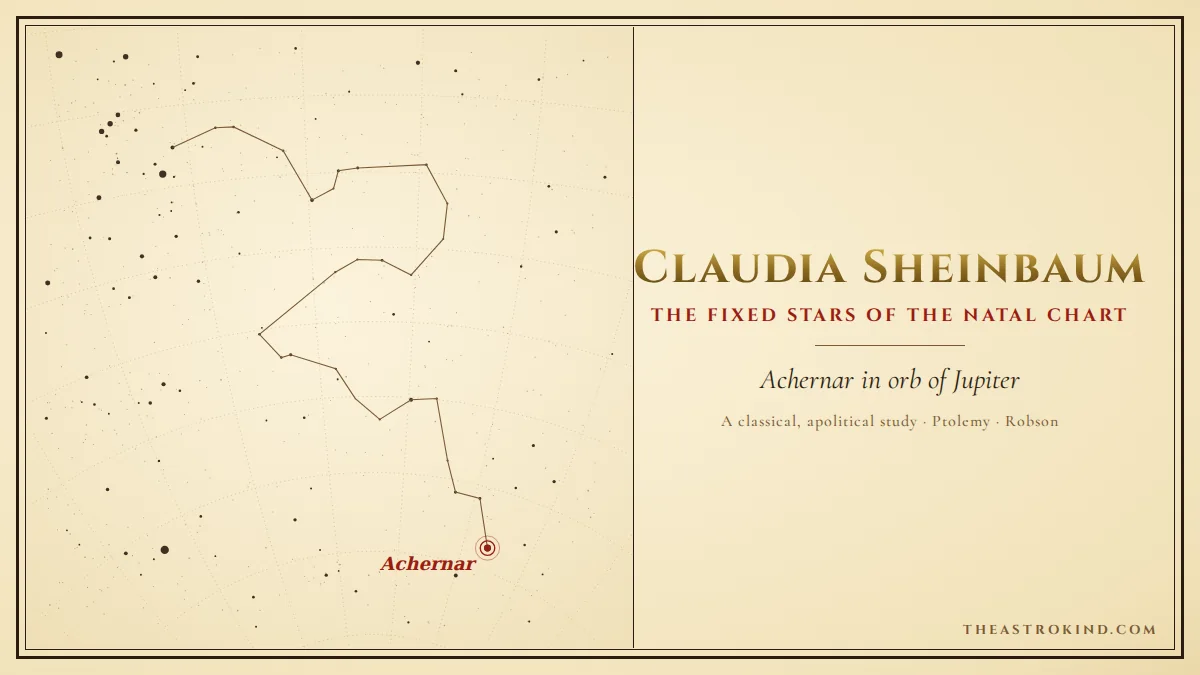
This is a clean, apolitical astrological examination of the fixed stars in the natal chart of Claudia Sheinbaum. It takes no side, it is not an opinion for or against her or her party, and it does not predict any election. The birth time is not known with certainty; the chart used here is cast for an approximate time of 12:00 local, so I will not draw conclusions from the Ascendant, Midheaven, houses, stars on the angles, the Part of Fortune, or the exact degree of the Moon, which moves about 13 degrees a day. Instead, I will focus on the fixed-star conjunctions to the Sun and the slow planets, which hold for the whole day and are therefore reliable.
The Fixed Stars in the Natal Chart of Claudia Sheinbaum: A Methodological Note
Before examining the stars, it is important to clarify the method. The fixed stars are not planets; they are distant suns that, in classical astrology, act as amplifiers or modifiers of planetary significations. Their influence is most potent when they are conjunct a planet within a small orb, typically 1 to 2 degrees. In this chart, we find several close conjunctions to the Sun, Moon, and outer planets. The doctrine I follow is that of Ptolemy in the Tetrabiblos, and Vivian Robson in his 1923 work Fixed Stars and Constellations in Astrology, which remains the standard reference for the nature and effects of the stars.
The target keyword, fixed stars in the natal chart of Claudia Sheinbaum, will guide our exploration. We will examine each conjunction in turn, starting with the most personal—the Sun—and then moving to the slower planets, which describe generational and public themes.
The Sun Conjunct Propus: Eminence and Vigilance
The Sun is conjunct the fixed star Propus with an orb of only 0.18 degrees. This is a very tight conjunction, and according to Robson, Propus is of the nature of Mercury and Venus. It signifies eminence, strength, success, a quick mind, protection, and vigilance. In the chart, the Sun is in Cancer, in the tenth house, which is the house of public standing and career. The Sun is also the lord of the twelfth house, which classical authors associate with hidden matters, isolation, and enemies. This combination suggests that her public eminence (Sun in the tenth) is connected to matters of the twelfth house—perhaps behind-the-scenes work, research, or dealing with hidden opposition. The star Propus adds a sharp intellect and a protective quality, but also a need for vigilance.
Robson notes that Propus gives "eminence, force, success, a quick mind, protection and vigilance." This is a star that favors those in public life, but it also warns that success must be guarded. The Sun is peregrine, meaning it has no essential dignity, so the star's influence is not backed by planetary strength; it acts as an external boost, but one that requires effort to maintain.
The Moon and the Stars of the Deep
The Moon is conjunct several stars: Scheat (orb 0.74°), Deneb Kaitos (0.80°), and Kerb (0.95°). These are all stars in or near the constellation of Pisces and Aquarius, and they carry a watery, Saturnine, and sometimes difficult symbolism. Robson describes Scheat as giving "great sensitivity, prophetic intuition, but warns of tragedy related to water or great losses." Deneb Kaitos is of the nature of Saturn and signifies "self-destruction, inhibition, disease, forced migrations, and isolation." Kerb, of Saturn and Jupiter, warns of "danger of death by drowning or suffocation, an impulsive nature associated with water and floods."
However, the Moon is in Pisces, a water sign, and is peregrine. These stars add emotional depth and intuition, but also a sense of vulnerability and sensitivity to collective undercurrents. In a public figure, this can manifest as an ability to connect with the masses on an emotional level, but also as exposure to public opinion and the tides of fortune. The Moon is also conjunct the star Achernar? No, Achernar is conjunct Jupiter. The Moon's conjunctions are not the most prominent in this chart, but they do add a layer of emotional intensity and perhaps a connection to water-related issues or public sentiment.
Neptune and the Stars of Mysticism and Justice
Neptune is conjunct several stars: Mimosa (0.19°), Acrux (0.41°), Alphecca (0.83°), and Menkent (0.85°). These are stars of a spiritual, mystical, and sometimes judicial nature. Mimosa, of Jupiter and Venus, is associated with "astrology, mysticism, prophecy, and ancient wisdom." Acrux, of Jupiter, signifies "ceremony, justice, magic, and mysticism, with a deeply spiritual nature and interest in the occult." Alphecca, of Venus and Mercury, gives "honor, dignity, and artistic or poetic talent, with lasting success through patient merit and elegance." Menkent, of Venus, indicates "erudition, learning, philosophy, companionship, and constant devotion, with a calm and studious nature."
Neptune is in Scorpio in the second house, which relates to finances and resources. These stars suggest that her approach to resources and values may have a spiritual or idealistic dimension, and that she may be drawn to matters of justice and ceremony. The star Alphecca, in particular, promises lasting success through patient merit, which is a valuable asset in public life. However, Neptune is peregrine, so these influences are not integrated with planetary dignity; they act as a backdrop of idealism and perhaps a tendency to be seen as a visionary or a mystic.
Uranus and the Royal Star Regulus
Uranus is conjunct Regulus with an orb of 1.78 degrees. Regulus is one of the four Royal Stars of Persia, the Heart of the Lion, of the nature of Mars and Jupiter. Robson says it gives "glorious conquests, great fortune, leadership, and nobility. It grants a meteoric rise, but with the strict warning to avoid revenge to preserve greatness." This is a powerful star, and its conjunction with Uranus, the planet of sudden changes and innovation, suggests a potential for a dramatic and unconventional rise to prominence. Uranus is also conjunct Al Jabhah (0.15°), a star of Saturn and Mercury that Robson associates with "losses, danger, law and order, a violent nature, and a turbulent life." And Adhafera (0.49°), of Saturn and Mercury, which Robson links to "criminal tendencies, poisoning, corrosive substances, suicide or violent death." These are harsh stars, but we must remember that they are conjunct Uranus, which is in Leo in the twelfth house. The twelfth house is associated with hidden matters, and Uranus there may indicate sudden changes coming from behind the scenes or through unconventional means.
The combination of Regulus and Al Jabhah is contradictory: one promises glory, the other warns of downfall. In classical astrology, the outcome depends on the overall chart and the moral conduct of the native. Robson explicitly warns that with Regulus, one must avoid revenge to retain greatness. This is a moral injunction, not a prediction.
Jupiter, Pluto, and the Stars of Public Honor
Jupiter is conjunct Achernar (2.17°), a star of Jupiter that Robson says gives "success in public office or religion, deep spirituality, benevolence, and lasting honor." Jupiter is in Pisces in the sixth house, which relates to service and work. This suggests that her public success may come through service and a benevolent approach to work. Pluto is conjunct Alioth (0.55°), a star of Mars that Robson associates with "danger, anger, a destructive nature, collective catastrophes, fires, and perseverance." Pluto is in Virgo in the twelfth house, again emphasizing hidden or collective matters. The star Alioth adds a note of intensity and potential for upheaval, but also perseverance.
These stars, while not as tight as the Sun's conjunction, add a layer of public honor and potential for transformative action. Jupiter's conjunction with Achernar is particularly fortunate for public office, reinforcing the theme of service and honor.
In practice
- Focus on the Sun and slow planets: When the birth time is uncertain, rely on fixed-star conjunctions to the Sun and outer planets, as they remain valid for the entire day.
- Weigh the star's nature: Use Robson's descriptions to understand the star's character, and consider the planet's condition and house placement for context.
- Look for tight orbs: Conjunctions within 1 degree are most powerful; those within 2 degrees are still significant but less intense.
- Avoid fatalism: Fixed stars indicate potentials and tendencies, not inevitable events; they interact with the planet's dignity and the native's free will.